

Your technical product solves problems you haven’t discovered yet.
For technical B2B manufacturers, the struggle is real. You have an incredible product—a sensor, an actuator, an electromechanical assembly—but you can’t possibly identify every potential application across every industry. This is the core challenge in developing use cases for technical products. Your teams are lean, your engineering resources are focused on the next product iteration, and you lack the time to create the custom, application-specific content that buyers demand.
Here’s the thing: this isn’t just a content problem. It’s a strategic blind spot. Every day you’re not systematically exploring new applications is a day your competitors might be discovering markets you didn’t even know existed.
This guide provides a strategic framework to solve that. We will show you how to transform use case development from a time-consuming writing exercise into a powerful engine for market discovery and sales enablement. You will learn how to uncover new applications, create compelling content that converts, and prove your marketing ROI, even with a small team.
Key Takeaway: Use cases are not just marketing collateral; they are a strategic tool for discovering new markets and empowering your sales team to close more deals.
What Are Use Cases (And Why Technical B2B Manufacturers Need Them)
In the world of technical products, terminology can be a minefield. Before we go further, it’s vital to establish a clear understanding of what a use case is, especially in contrast to other common content formats like case studies and application notes. This clarity is the first step toward creating content that truly resonates with your target audience.
The Definition: Use Cases vs. Case Studies vs. Application Notes
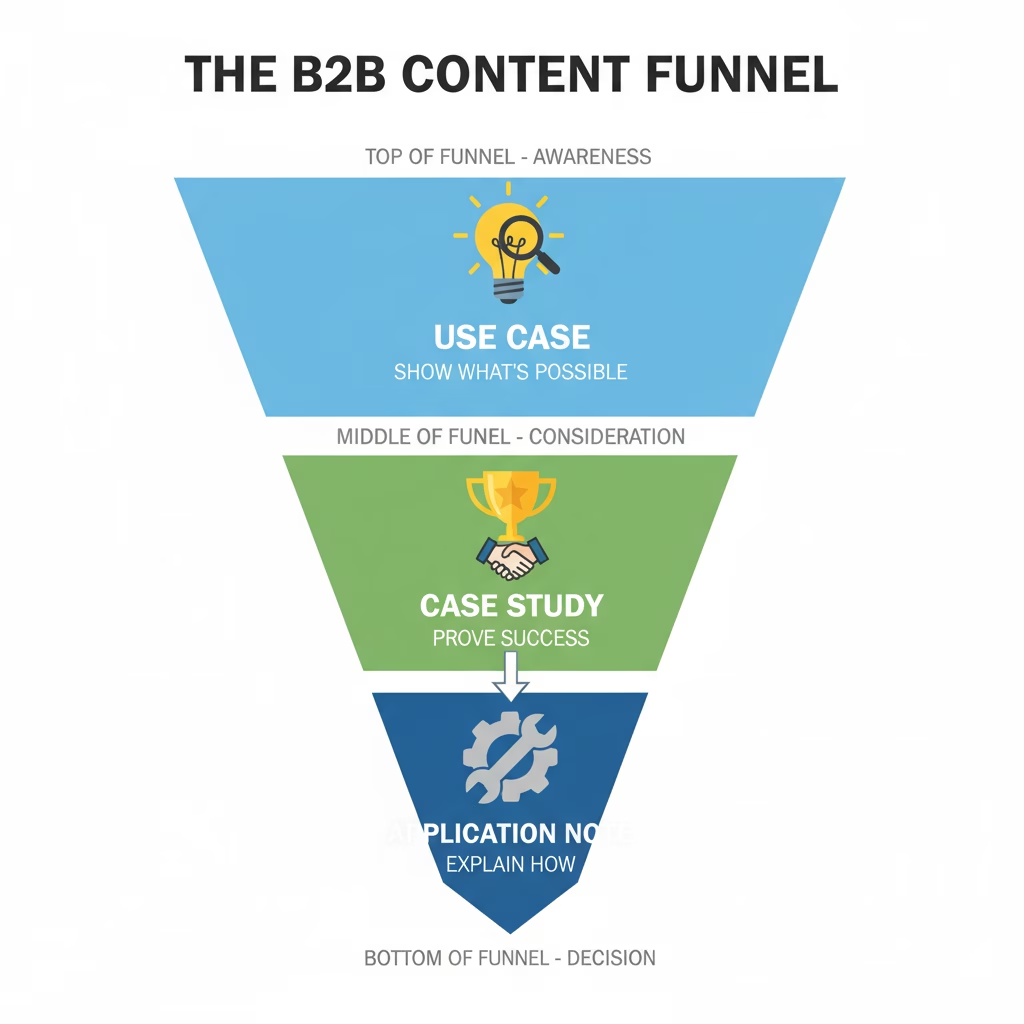
These three formats serve different purposes and address different stages of the buyer’s journey. A use case shows what is possible, a case study proves what has been done, and an application note explains how to do it. Understanding this distinction is fundamental to building an effective content strategy.
Each format has a specific role. Use cases are for top-of-funnel discovery, case studies are for mid-funnel validation, and application notes are for bottom-of-funnel implementation. Using the right tool for the right job prevents you from showing up with a detailed schematic when the customer is still just trying to understand if you can solve their problem at all.
| Format | Primary Purpose | Focus | Audience | Key Question Answered |
|---|---|---|---|---|
| Use Case | Show what is possible | Hypothetical problem-solution | Prospects in new markets | “Could this product solve my specific problem?” |
| Case Study | Prove what has been done | Real-world customer success | Prospects evaluating vendors | “Has this company successfully solved a problem like mine?” |
| Application Note | Explain how to do something | Technical implementation | Engineers and integrators | “How do I integrate this product into my system?” |
Why Use Cases Matter More Than Ever in 2025
The B2B buying landscape has fundamentally changed. According to a 2024 study from TechTarget, 92% of technology decision-makers begin their research when they uncover a problem, long before they have a budget or a vendor in mind [1]. They consume an average of 12 pieces of content while researching and shortlisting vendors. Simultaneously, a staggering 66% of manufacturers report that their existing content isn’t converting [2].
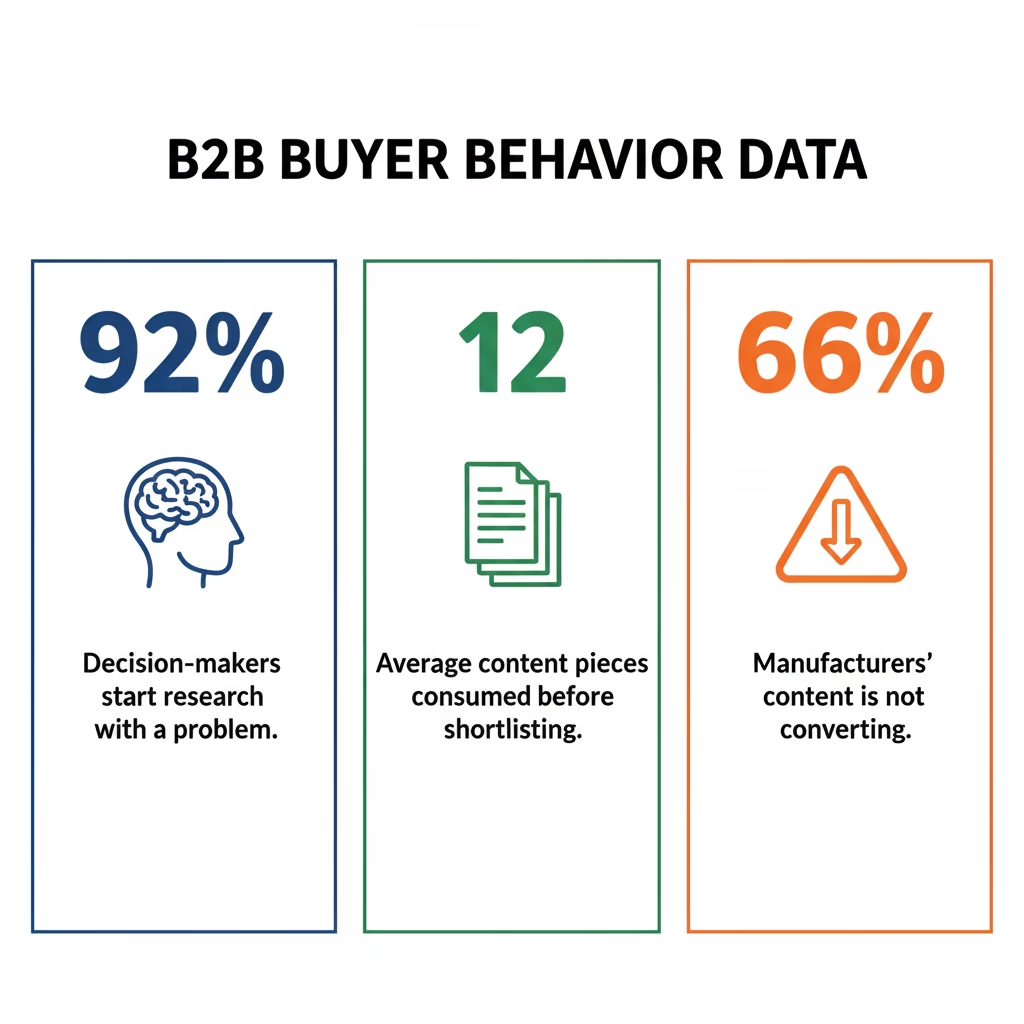
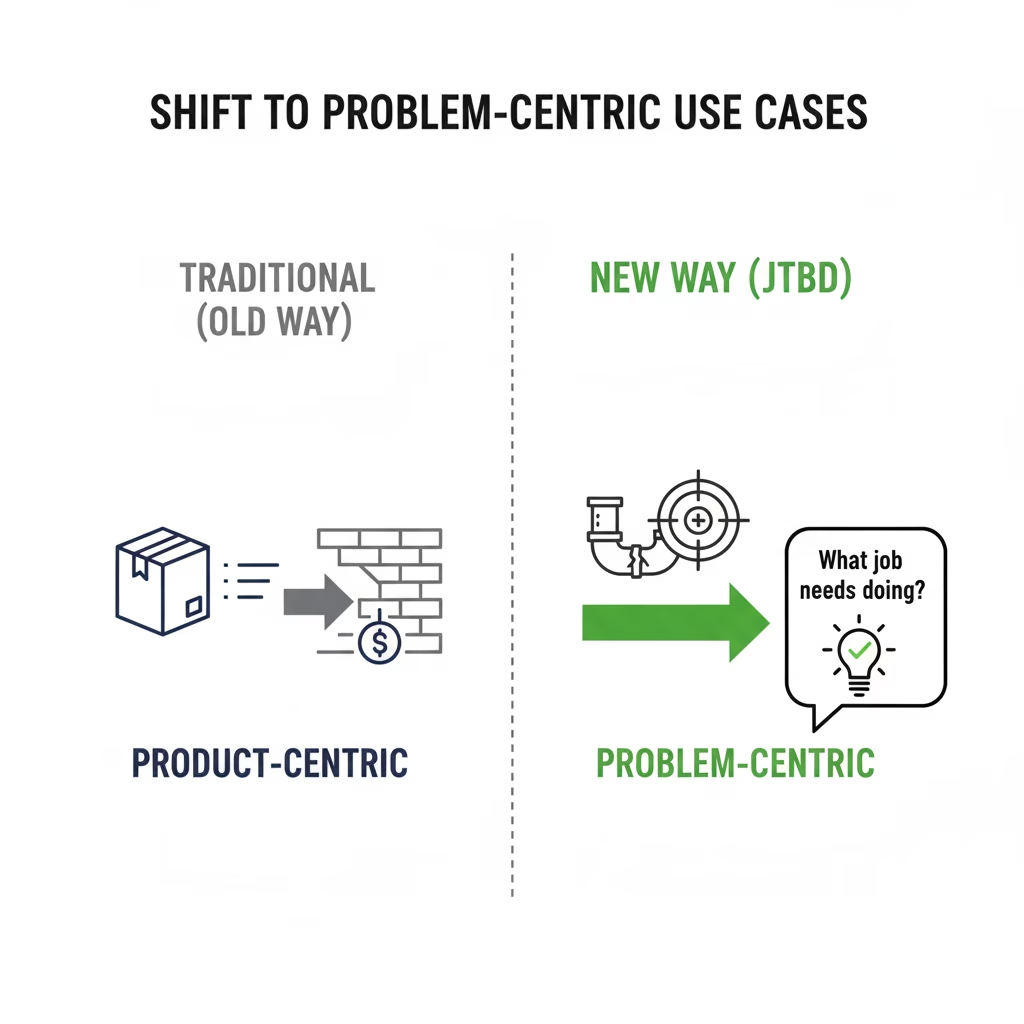
This disconnect happens because most manufacturing content is still product-centric, not problem-centric. Buyers are searching for solutions to their problems, but they are finding a wall of feature lists and technical specifications. Use cases bridge this gap. They translate your product’s technical capabilities into a problem-solution narrative that a potential customer can immediately understand and relate to.
Key Takeaway: Your buyers are not looking for your product; they are looking for a solution to their problem. Use cases frame your product as that solution.
The 2025-2026 Shift in Technical Buyer Behavior
The way technical buyers research and evaluate solutions has evolved dramatically. Recent data from the Content Marketing Institute reveals that 95% of B2B marketers are now using AI-powered applications in their workflows [5]. But here’s what’s more interesting: buyers themselves are using AI to research solutions. They’re asking ChatGPT and Claude to compare products, summarize specifications, and identify potential applications.
What does this mean for your use cases? They need to be structured in a way that both humans and AI can easily parse and understand. Clear problem statements, explicit benefit claims, and well-organized technical details are no longer just nice-to-have; they’re essential for being discovered and recommended by AI research assistants.
Additionally, the Content Marketing Institute found that 61% of B2B marketers report improvement in their content strategy, with 74% crediting strategy refinement (not just new technology) as the biggest driver [5]. The winners in 2026 aren’t just using more tools; they’re thinking more strategically about what content to create and why.
Expert Insight: “We used to create use cases based on what we thought was interesting about our product. Now, we start with sales call recordings and customer support tickets. The best use cases come from real pain points we hear over and over.” — Sarah Chen, Technical Marketing Manager at a sensor manufacturer
The Hidden Value: Use Cases as Market Discovery Tools
Most companies treat use cases as a marketing asset, a piece of collateral to be created and distributed. This is a limited view. The true power of use case development lies in its function as a strategic tool for market discovery. The process of creating a use case forces you to think deeply about applications, industries, and pain points you may have previously overlooked.
A well-developed use case can help you:
- Identify New Applications and Markets: Systematically exploring potential problems your product could solve can reveal lucrative new verticals.
- Enhance Sales Enablement: A library of use cases is a powerful tool for training sales engineers to spot opportunities and handle objections.
- Inform Product Roadmap: Understanding how customers could use your product can highlight feature gaps and inform future development priorities.
- Sharpen Competitive Positioning: Analyzing how your product solves problems differently or better than competitors creates a stronger value proposition.
The Jobs-to-be-Done Foundation for Use Case Development
To create use cases that resonate, you must first understand why customers make choices. The Jobs-to-be-Done (JTBD) framework, pioneered by Clayton Christensen, provides a powerful lens for this. It argues that customers don’t buy products; they “hire” them to do a “job.” This shift in perspective is critical for developing effective use cases.
Why Traditional Buyer Personas Fail for Technical Products
Many marketing teams spend countless hours creating detailed buyer personas: “Engineering Eric, 45, loves fishing and drives a Ford F-150.” While these details might feel insightful, they rarely explain why Eric would choose your valve over a competitor’s. As a Forbes article on the topic notes, these demographic and psychographic details are often irrelevant to the actual purchase decision [3].
The JTBD framework abandons these superficial details and focuses instead on the circumstances, motivations, and desired outcomes that drive a customer to seek a new solution. It’s not about who they are, but what they are trying to accomplish.
Key Takeaway: Stop focusing on who your buyer is and start focusing on what job they are trying to get done. This is the key to unlocking powerful use cases.
The Four Elements of JTBD for Use Cases
To apply JTBD to use case development, you need to understand four key components that form the narrative of any purchase decision:
| Element | Description | Example for a Sensor Manufacturer |
|---|---|---|
| The Job to be Done | The progress a customer is trying to make in a specific circumstance. | “I need to ensure the purity of a liquid in my production line to meet regulatory standards.” |
| The Pain Points | The struggles and frustrations with the current solution. | “Manual sampling is slow, prone to human error, and can’t provide real-time data.” |
| The Desired Outcomes (KPIs) | The measurable results the customer wants to achieve. | “Reduce batch contamination by 90%; decrease testing time by 50%; automate compliance reporting.” |
| The Triggers | The event that initiates the search for a new solution. | “We just failed a regulatory audit and have 60 days to implement a corrective action.” |
How to Conduct JTBD Research for Technical Products
Uncovering the “job” requires a different kind of research. It’s less about asking customers what they want and more about understanding their struggles. You need to become a detective, piecing together the story of why someone would seek out a new solution.
The most effective method is the structured customer interview. But you can’t just ask, “What do you need?” That question produces feature lists, not insights. Instead, use these question frameworks:
Questions About the Triggering Event:
- “When did you first realize you needed a different solution?”
- “What happened that made you start looking?”
- “Walk me through the moment when you knew the old way wasn’t working.”
Questions About Pain Points and Struggles:
- “What were you doing before to solve this problem?”
- “What was frustrating about that approach?”
- “What was the cost (time, money, risk) of continuing with the old way?”
- “What workarounds had you tried?”
Questions About Desired Outcomes:
- “If this solution worked perfectly, what would change for you?”
- “How would you measure success?”
- “What would this enable you to do that you can’t do now?”
- “What would your boss say if this worked?”
Questions About the Decision Process:
- “Who else was involved in this decision?”
- “What were their concerns?”
- “What almost stopped you from moving forward?”
- “What made you choose this solution over the alternatives?”
Beyond customer interviews, you can mine JTBD insights from:
- Sales Call Recordings: Listen for the language customers use to describe their problems.
- Sales Engineer Debriefs: They hear the unfiltered version of customer struggles every day.
- Support Tickets: Recurring issues often point to unmet “jobs.”
- Online Forums and Communities: Where do your target customers gather online? What are they complaining about?
Expert Insight: “The best use case ideas come from listening to what our sales engineers say after they lose a deal. They’ll say, ‘We lost because they needed X and we couldn’t prove we could do it.’ That’s a use case we need to create.” — Mike Rodriguez, Sales Engineer with 15 years in industrial automation
The 7-Step Use Case Development Framework
Now that we have the strategic foundation, let’s move to execution. This 7-step framework is designed to be a repeatable process for developing high-impact use cases for technical products. It takes you from initial market discovery all the way to a sales-ready narrative.
Step 1: Identify Market Opportunities and Customer Pain Points
Great use cases start with identifying unsolved problems. Before you even think about your product, you must understand the landscape of customer needs. According to Nutshell, new market opportunities often reveal themselves through patterns in customer pain points, competitor blind spots, or shifting industry trends [4]. Use these methods to find them:
- Analyze Customer Feedback: Systematically review support tickets, sales call notes, and online reviews. What are the recurring complaints or feature requests?
- Conduct Competitive Analysis: Where are your competitors focused? What applications or industries are they ignoring? This is often where the most significant opportunities lie.
- Evaluate Internal Capabilities: What are the unique technical strengths of your product? Could these strengths be applied to solve problems in adjacent markets?
- Interview Your Sales and Field Engineers: Ask them, “What are the most common and surprising problems you see customers trying to solve with our products?”
- Look for Economic and Regulatory Shifts: New regulations (like those for food safety or emissions) or economic pressures (like rising energy costs) create new “jobs” that need doing.
- Monitor Industry Trends: What are the emerging technologies or processes in your target industries? How might your product enable or enhance them?
- Analyze Search and Social Data: What questions are people asking online? What problems are they discussing in industry forums?
Step 2: Define the Target User and Context
Once you have identified a potential problem, you need to get specific about who is experiencing it. This is not about demographics, but about roles and responsibilities. For example, instead of “manufacturing companies,” get specific: “a maintenance manager at a mid-sized food processing plant in the EU.” This context is crucial for creating a relatable narrative.
Define the context by answering:
- Role: What is their job title and primary responsibility?
- Industry: What specific industry vertical?
- Company Size: SME, mid-market, or enterprise?
- Geography: Are there regional considerations (regulations, climate, infrastructure)?
- Constraints: What limitations do they operate under (budget, space, existing systems)?
Key Takeaway: Specificity is your friend. A use case for a “maintenance manager” is far more powerful than one for a “company.”
Step 3: Map the Customer’s Current State (The “Before” Snapshot)
Before you can introduce your solution, you must paint a vivid picture of the customer’s current pain. This is the most critical part of the use case narrative. Detail the problems, the workarounds they are currently using, and the costs associated with their current state. A useful framework is to document:
- The Problem: What is the core issue they are facing? (e.g., “Unscheduled downtime due to valve failure.”)
- The Workaround: What are they doing now to mitigate this? (e.g., “Performing manual valve inspections every week.”)
- The Cost: What is the impact of this problem in terms of time, money, or risk? (e.g., “Each hour of downtime costs $50,000 in lost production.”)
- The Emotional Impact: How does this problem make them feel? Stressed? Frustrated? Vulnerable?
The more vividly you can describe this “before” state, the more compelling your use case will be. Use specific numbers, quotes, and scenarios to make it real.
Step 4: Describe the Future State (The “After” Snapshot)
Now, you introduce your product as the hero of the story. Describe how your product solves the problem and creates a new, better reality. Crucially, you must connect your product’s features to measurable benefits. Don’t just say your sensor is “more accurate”; explain that its accuracy “reduces false positives by 95%, saving 10 hours of manual verification per week.”
Structure the “after” state to mirror the “before”:
- The Solution: How does your product address the core problem?
- The New Process: What does the workflow look like now?
- The Measurable Outcomes: What are the quantified improvements? (time saved, cost reduced, risk eliminated)
- The Emotional Payoff: How does the customer feel now? Confident? Efficient? Secure?
Step 5: Build the Narrative and Technical Details
This is where you weave the story together. Describe a plausible scenario. For example, “A maintenance manager at a chemical processing plant was struggling with…” Then, introduce the relevant technical details of your product that enable the solution. This is not a full data sheet, but a curated selection of specifications that are directly relevant to the use case. If your valve’s corrosion resistance is key, highlight that material and its performance data. The goal is to provide enough technical depth to be credible to an engineer, without overwhelming a business decision-maker.
Balance is everything. A good rule of thumb: if a technical detail doesn’t directly support the problem-solution narrative, leave it out. You can always link to a full spec sheet for those who want more.
Step 6: Add Proof Points and Validation
To build trust, you need to back up your claims. Since a use case is often hypothetical, you can use a variety of proof points:
- Data and Statistics: Cite industry benchmarks or performance data from your own lab testing.
- Customer Quotes: Even if you don’t have a full case study, a quote from a customer experiencing a similar problem can be powerful.
- Industry Standards: Mention any certifications (e.g., IP69K, ATEX) that are relevant to the application.
- Competitive Comparisons: If you have a clear, defensible advantage, a simple comparison table can be very effective.
- Third-Party Validation: Awards, analyst reports, or media mentions can add credibility.
Key Takeaway: Proof points turn a hypothetical story into a believable solution. Use data, even if it’s not from a direct customer, to substantiate your claims.
Step 7: Create Clear Next Steps and CTAs
A use case should always guide the reader to the next logical step. Don’t leave them hanging. The call-to-action (CTA) should be relevant to the use case and the buyer’s stage. For a top-of-funnel use case, a high-pressure “Buy Now” CTA will fail. Instead, offer:
- A link to a more detailed application note.
- An invitation to a webinar on a similar topic.
- A consultation with a sales engineer to discuss their specific application.
- A downloadable guide or template.
- A product demo or trial.
Your First Use Case: A 30-Day Action Plan
The 7-step framework is comprehensive, but it can feel overwhelming if you’re starting from scratch. Here’s a realistic 30-day plan to create your first high-quality use case:
Week 1: Discovery and Research
- Day 1-2: Review the last 10 sales calls (recordings or notes). Identify the top 3 recurring customer problems.
- Day 3-4: Interview 2-3 sales engineers. Ask them about the most common applications and the deals they wish they had a use case for.
- Day 5: Choose one specific problem/application to focus on. Define the target user and context.
Week 2: Outline and Draft
- Day 6-7: Map out the “before” state. Document the problem, workaround, and costs in detail.
- Day 8-9: Describe the “after” state. How does your product solve the problem? What are the measurable outcomes?
- Day 10: Write the first draft of the narrative. Don’t worry about perfection; just get the story down.
Week 3: Refinement and Validation
- Day 11-12: Add technical details and proof points. Gather relevant specs, certifications, and data.
- Day 13-14: Get feedback from a sales engineer and a product manager. Does it ring true? Is anything missing?
- Day 15: Revise based on feedback. Tighten the narrative and ensure the technical details support the story.
Week 4: Finalization and Launch
- Day 16-17: Format the use case for publication (PDF, web page, etc.). Add visuals if possible (diagrams, photos).
- Day 18-19: Create a promotion plan. Where will you share this? Email, LinkedIn, sales enablement library?
- Day 20: Publish and promote. Share it with your sales team first, then with your broader audience.
Days 21-30: Monitor and Iterate
- Track engagement metrics (views, downloads, shares).
- Gather feedback from sales team and prospects.
- Make adjustments based on what you learn.
By the end of 30 days, you’ll have a complete, validated use case and a repeatable process for creating more.
Use Case Examples from Industrial B2B Leaders
Theory is great, but seeing it in action is better. Let’s break down a few examples of effective use cases for technical products, focusing on the problem-solution narrative.
Example 1: Pressure Sensor for HVAC Optimization
- Industry: Commercial Building Automation
- The Problem: A facility manager for a large office building is facing pressure to reduce energy costs, but their HVAC system runs at a constant speed, wasting energy during periods of low occupancy.
- The Solution: A differential pressure sensor is installed in the ventilation ducts. It provides real-time data on air pressure, allowing the building management system to adjust fan speeds based on actual demand.
- The Outcome: The facility manager can now implement a variable air volume (VAV) system, leading to a 15-20% reduction in HVAC energy consumption and a measurable decrease in operational costs.
- What Makes This Effective: It connects a technical product (a sensor) to a clear business outcome (cost savings). It also addresses a timely concern (energy efficiency) that many facility managers are being measured on.
Example 2: Electromechanical Actuator for Food Processing
- Industry: Food and Beverage Manufacturing
- The Problem: A food processing plant uses hydraulic actuators on its packaging line. These actuators are a constant source of concern due to the risk of hydraulic fluid leaks, which would lead to product contamination and a costly recall.
- The Solution: The hydraulic actuators are replaced with electromechanical actuators that have an IP69K rating, certifying them for high-pressure, high-temperature washdowns.
- The Outcome: The risk of fluid contamination is eliminated, improving food safety and compliance. Maintenance is also simplified, reducing downtime.
- What Makes This Effective: It addresses a critical industry-specific pain point (contamination risk) and highlights a key feature (IP69K rating) as the solution. It speaks directly to a regulatory concern that keeps plant managers up at night.
Key Takeaway: The best use cases are specific. They focus on a single industry, a single problem, and a single, clear outcome.
Example 3: Industrial Valve for Chemical Processing
- Industry: Chemical Manufacturing
- The Problem: A chemical plant experiences frequent production shutdowns because the standard valves in their lines are corroding due to the harsh chemicals being processed. Each shutdown costs thousands in lost production and maintenance hours.
- The Solution: The standard valves are replaced with valves made from a specialized corrosion-resistant alloy. These new valves are also equipped with sensors that provide predictive maintenance data.
- The Outcome: Unplanned downtime is reduced by 40%. The maintenance team can now schedule valve replacements proactively, before a failure occurs.
- What Makes This Effective: It combines a product feature (corrosion-resistant material) with a service-oriented benefit (predictive maintenance) to solve a high-stakes problem. It shows a clear ROI that a CFO would approve.
How to Create Use Cases Fast (Even with a Team of One)
The reality for most SME manufacturers is that resources are tight. A 2025 survey found that 57% of manufacturing marketers cite a lack of resources as their biggest challenge, and 50% say they simply can’t produce enough content [2]. The 7-step framework is powerful, but it can seem daunting. Here’s how to accelerate the process without sacrificing quality.
The Resource Reality for SME Manufacturers
The typical manufacturing marketing department is not a sprawling team of specialists. It’s often one or two people responsible for everything: strategy, content, digital marketing, events, and sales enablement. They don’t have dedicated writers or an army of engineers on standby for marketing content. This is why an efficiency-first mindset is not just a nice-to-have; it’s a survival requirement.
But wait, there’s more to this story. The resource constraint isn’t just about headcount. It’s also about expertise. Many manufacturing marketers come from a general marketing background and lack deep technical knowledge. Meanwhile, the engineers who do have that knowledge are focused on product development, not content creation. This creates a gap that use case templates and AI tools can help bridge.
Templates and Frameworks That Accelerate Creation
Don’t reinvent the wheel every time. Use templates to structure your thinking and ensure you cover all the critical elements. A simple use case outline template can cut your creation time in half. We have created a downloadable pack of templates to get you started, including:
- A customer interview guide for JTBD research.
- A one-page use case outline template.
- A before/after comparison table.
- The Use Case Canvas (described below).
- A use case ROI calculator.
Key Takeaway: Templates are your best friend. Standardizing your process is the fastest way to increase your output and maintain quality.
The Use Case Canvas: A Visual Framework
Inspired by the Business Model Canvas, we’ve developed a proprietary tool called the Use Case Canvas. It’s a one-page visual framework that helps you organize all the key elements of a use case before you start writing. The canvas has eight sections:
| Canvas Section | What Goes Here |
|---|---|
| 1. Target User | Role, industry, company size, geography |
| 2. The Job to be Done | What progress are they trying to make? |
| 3. Pain Points | Current struggles and frustrations |
| 4. Triggers | What event prompts them to seek a solution? |
| 5. Current State | How are they solving this today? What’s the cost? |
| 6. Your Solution | How does your product solve the problem? |
| 7. Future State | What does success look like? Measurable outcomes? |
| 8. Proof Points | Data, certifications, customer quotes, competitive advantages |
By filling out the canvas first, you create a clear blueprint for your use case. This prevents the common problem of starting to write and realizing halfway through that you’re missing critical information. A completed canvas can be filled out in 30-45 minutes and makes the actual writing process much faster.
AI-Assisted Use Case Development
Artificial intelligence is a massive accelerator, if used correctly. While 89% of B2B marketers are using AI content tools, many are still in the exploratory phase [5]. Here’s a practical workflow that works:
Phase 1: AI for Research and Ideation
- Use AI to summarize industry trends and identify common pain points for a specific role.
- Ask it to generate a list of potential applications for your product in a specific industry.
- Have it find relevant statistics or case studies from public sources.
Phase 2: AI for First Draft
- Once you have your Use Case Canvas filled out, provide it to an AI tool (ChatGPT, Claude, etc.) along with a prompt like: “Write a 1,000-word use case based on this canvas. Use a problem-solution narrative structure.”
- The AI will generate a first draft that covers the key points.
Phase 3: Human Expertise for Refinement (CRITICAL)
- This is where the magic happens. An AI-generated draft will be generic and lack the technical nuance and industry-specific insights that make a use case credible.
- Your internal experts—sales engineers, product managers, and even friendly customers—must review, edit, and add the specific details that only they know.
- This is also where you add the “voice” that makes the content feel human and authentic.
Think of AI as a junior writer who can create a solid first draft, but needs an experienced editor to make it great. This approach can reduce your use case creation time by 50-60%, but only if you don’t skip the human refinement step.
Expert Insight: “We use AI to generate the first draft of every use case now. It saves us probably 3-4 hours per piece. But we always have a sales engineer and a product manager review it before it goes live. That’s where the real value gets added.” — Jennifer Park, Content Marketing Manager at an actuator manufacturer
The Essential Technology Stack for Efficient Use Case Development
You don’t need a massive budget to create great use cases, but having the right tools makes a huge difference. Here’s a practical tech stack for resource-constrained teams:
| Tool Category | Recommended Tools | Why It Matters |
|---|---|---|
| CRM & Marketing Automation | HubSpot, Salesforce | Track which use cases prospects engage with; measure influence on deals |
| AI Writing Assistant | ChatGPT Plus, Claude Pro, Jasper | Accelerate research and first-draft creation |
| Content Management | Notion, Airtable, Google Docs | Organize use case library; track status and performance |
| Design & Visuals | Canva, Figma | Create diagrams, infographics, and formatted PDFs |
| Analytics | Google Analytics, Databox | Track engagement metrics and content performance |
| Collaboration | Slack, Microsoft Teams | Get quick feedback from sales and engineering teams |
| SEO & Research | Ahrefs, SEMrush (or free: Google Keyword Planner) | Identify what problems your audience is searching for |
You don’t need all of these tools on day one. Start with a CRM (if you don’t have one, HubSpot’s free tier is excellent), an AI writing assistant, and a simple content management system like Google Docs or Notion. Add the others as your use case program matures.
Repurposing Use Cases Across Channels
A single use case is not a single piece of content. It’s a source of multiple assets. A well-developed use case can be repurposed into:
- A detailed blog post (like this one).
- A slide in a sales presentation.
- A series of social media posts (LinkedIn, Twitter).
- A script for a short video (2-3 minutes).
- A topic for a webinar or podcast episode.
- An email nurture sequence (problem → solution → CTA).
- A one-page PDF for sales engineers to send to prospects.
This “create once, distribute many” approach maximizes the ROI on the time you invest in developing the initial use case. One use case can easily become 10-15 pieces of content across different formats and channels.
Integrating Use Cases into Your Technical Sales Process
Use cases are not just for marketing; they are a critical sales enablement tool. When sales and marketing are aligned around a common set of use cases, the entire sales process becomes more efficient and effective. According to research from Highspot, sales processes should be dynamic and informed by feedback from both reps and customers [6]. Use cases provide a perfect vehicle for this alignment.
Use Cases in Discovery and Qualification
In the technical sales process, the discovery call is everything. This is where a sales engineer uncovers the customer’s true needs. A library of use cases can supercharge this process. A sales engineer can use them to:
- Start Conversations: “We worked with a company in the chemical industry that was facing a similar challenge. Does this sound familiar?”
- Qualify Opportunities: By presenting a relevant use case, a sales engineer can quickly gauge if a prospect has a similar, high-value problem.
- Reframe the Problem: As Vivun notes, the goal of discovery is to reframe the problem in a way that makes your solution the obvious choice [7]. A use case is a perfect tool for this reframing.
- Uncover Hidden Needs: Sometimes a prospect doesn’t know what’s possible. A use case can open their eyes to a solution they hadn’t considered.
Key Takeaway: Equip your sales engineers with a library of use cases. They will have more effective discovery calls and qualify opportunities faster.
Training Sales Engineers on Use Case Selling
Don’t just hand your sales team a folder of PDFs. Train them on how to use use cases as a strategic tool. This training should include:
- Role-playing scenarios: Practice using use cases to handle common objections like “We’re happy with our current solution” or “Your product is too expensive.”
- Customization workshops: Teach them how to quickly tailor a generic use case to a specific prospect’s situation. This might mean adjusting the industry, the scale, or the specific pain points.
- Feedback loops: Create a process for sales engineers to share insights from the field back to marketing. What use cases are working? What’s missing? This feedback is gold for refining your content strategy.
- Use case library navigation: Make sure they know how to quickly find the right use case for any situation. Tag your use cases by industry, problem, product line, and buyer stage.
Use Cases for Deal Acceleration
In the later stages of a complex sale, use cases can be instrumental in getting a deal over the finish line. They can be used to:
- Build a Business Case: A use case with clear ROI helps your champion sell the solution internally to economic buyers. It gives them the ammunition they need to justify the purchase.
- Align Multiple Stakeholders: A single, clear story can get everyone from engineering to procurement on the same page. It creates a shared understanding of the problem and the solution.
- Differentiate from Competitors: When a prospect is comparing two technically similar products, a compelling use case that speaks directly to their problem can be the deciding factor.
- Overcome Technical Objections: If a prospect is skeptical that your product can handle their specific requirements, a use case with relevant proof points can address those concerns.
The Use Case Maturity Model: Where Are You Now?
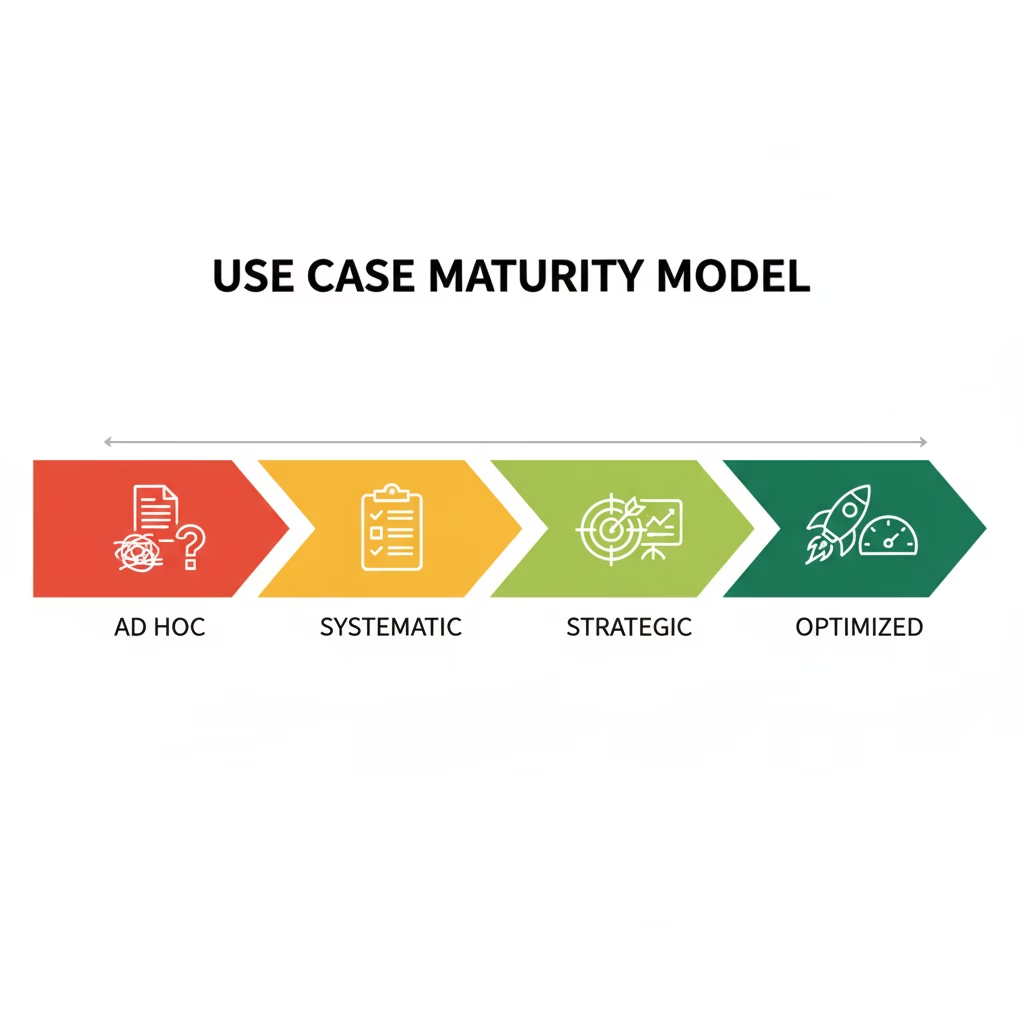
Not all use case programs are created equal. We’ve developed a maturity model to help you assess where your organization is today and chart a path forward. This model has four stages:
| Stage | Characteristics | Common Challenges | How to Progress |
|---|---|---|---|
| Stage 1: Ad Hoc | Use cases created sporadically, often by sales engineers for specific deals. No standard format or library. | Duplication of effort; inconsistent quality; hard to find existing use cases. | Create a central repository; establish a basic template; document existing use cases. |
| Stage 2: Systematic | Marketing owns use case creation. Standard template exists. Use cases published regularly. | Limited sales adoption; use cases created in silo without sales input; no measurement of effectiveness. | Involve sales in creation process; implement tracking and analytics; create feedback loop. |
| Stage 3: Strategic | Use cases inform market strategy. Sales and marketing collaborate. Performance is tracked and optimized. | Scaling creation to cover all key applications; keeping content up-to-date; proving ROI to leadership. | Implement AI-assisted creation; build use case library with search; create ROI dashboard. |
| Stage 4: Optimized | Use cases are core to go-to-market strategy. Continuous improvement based on data. Insights feed product development. | Maintaining momentum; avoiding complacency; staying ahead of market shifts. | Expand to customer-generated use cases; integrate with product roadmap; benchmark against competitors. |
Most SME manufacturers are at Stage 1 or early Stage 2. The good news is that moving from Stage 1 to Stage 2 can happen in a matter of months with the right focus. The key is to start with a few high-quality use cases, prove their value, and then systematically expand.
Key Takeaway: You don’t need to be at Stage 4 to see results. Even moving from Stage 1 to Stage 2 can dramatically improve your content effectiveness and sales enablement.
Measuring Use Case Effectiveness and Proving ROI
In today’s data-driven world, if you can’t measure it, you can’t manage it—and you certainly can’t get budget for it. A staggering 64% of manufacturers struggle to prove the ROI of their content marketing efforts, and 53% can’t tie their content to business outcomes [2]. This is a critical failure. A systematic approach to measuring use case performance is non-negotiable.
The Attribution Challenge for Technical Content
Attribution for B2B manufacturing is notoriously difficult. Sales cycles are long, often spanning months or even years. A single deal might involve dozens of touchpoints and multiple stakeholders. It’s naive to think you can draw a straight line from one use case download to a closed deal. However, that doesn’t mean you can’t measure impact. It just requires a more sophisticated approach.
The key is to think in terms of influence rather than attribution. Did a use case play a role in moving a deal forward? Did it help with qualification, education, or objection handling? These are the questions to ask.
Key Takeaway: Perfect attribution is a myth in complex B2B sales. Focus on influence and contribution rather than last-touch attribution.
Key Metrics for Use Case Performance
To prove the value of your use cases, you need to track a balanced set of metrics that cover engagement, lead generation, and sales influence. Here are the key metrics to focus on:
| Metric Category | Key Metrics | What It Tells You | Benchmark |
|---|---|---|---|
| Engagement | Page Views, Time on Page, Scroll Depth, Downloads | Is the content resonating with your audience? Are they finding it valuable? | 3+ min time on page; 60%+ scroll depth |
| Lead Generation | Form Fills (for gated use cases), Demo Requests, Consultation Sign-ups | Is the content compelling enough to drive action and convert anonymous visitors into known leads? | 5-10% conversion rate for gated content |
| Sales Influence | Deals Influenced (contacts on an open opportunity who viewed the use case), Sales Cycle Velocity, Sales Team Feedback | Is the content being used by the sales team and helping to move deals forward? | 20%+ of open deals influenced by use cases |
| SEO Performance | Organic Traffic, Keyword Rankings, Backlinks | Is the content driving discovery and building authority? | Top 10 ranking for target keywords within 6 months |
Building Your Use Case ROI Framework
A simple framework can help you connect your use case efforts to revenue. Here’s a step-by-step approach:
Step 1: Set Up Tracking
- Use your CRM to track which contacts have engaged with which use cases.
- Tag use cases with UTM parameters so you can track traffic sources.
- Set up goals in Google Analytics for key actions (downloads, demo requests).
Step 2: Define “Influenced Deals”
- In your CRM, create a report showing all open opportunities where at least one contact has viewed a use case.
- Track these deals separately to see if they close at a higher rate or have a shorter sales cycle.
Step 3: Calculate the Value
- If you find that deals influenced by use cases close 10% faster or at a 5% higher rate, you can calculate the revenue impact.
- Example: If you have $1M in pipeline and use cases increase close rate by 5%, that’s $50K in additional revenue attributable to your use case program.
Step 4: Report Regularly
- Create a quarterly dashboard showing use case performance across all metrics.
- Share this with sales leadership and executive team to demonstrate impact.
- Use the data to inform which use cases to create next.
This approach won’t give you perfect attribution, but it will give you a compelling narrative about the value of your use case program. And in most organizations, that’s enough to justify continued investment.
Common Use Case Development Mistakes (And How to Avoid Them)
Even with the best intentions, it’s easy to make mistakes when developing use cases. Here are four of the most common pitfalls and how to steer clear of them.
Mistake #1: Starting with Features Instead of Problems
This is the cardinal sin of technical content. It happens when the first question is, “What features do we want to highlight?” instead of, “What problem are we trying to solve?” The result is a use case that reads like a data sheet in paragraph form, and it fails to connect with buyers who are not yet experts in your product.
We saw this firsthand with a valve manufacturer who created a use case titled “High-Performance Valve with Advanced Sealing Technology.” It was full of impressive specs, but it didn’t answer the buyer’s fundamental question: “Why do I need this?” After reframing it as “Eliminating Unplanned Downtime in Chemical Processing,” with the same technical content but a problem-first narrative, engagement tripled.
How to Fix It: Ban the mention of product features in your initial brainstorming session. Start every use case discussion with the JTBD framework: What is the job? What are the pain points? What are the desired outcomes? Only after you have a deep understanding of the problem should you introduce your product as the solution.
Mistake #2: Being Too Technical or Too Generic
Finding the right balance of technical depth is a constant challenge. Some use cases are so filled with jargon and acronyms that they are incomprehensible to a business decision-maker. Others are so high-level and generic that they lack credibility with an engineering audience. Both fail.
A sensor manufacturer we worked with created a use case that said their product “improves efficiency.” That’s too generic. An engineer reading that would think, “How? By how much? In what application?” On the other end, another use case was titled “Implementing MEMS-based Piezoresistive Pressure Transducers for Differential Pressure Measurement in HVAC Systems.” That’s too technical for most readers.
How to Fix It: Write for the “informed generalist.” Assume your reader is smart and understands their industry, but is not an expert in your specific technology. Use clear, plain language. When you must use a technical term, briefly explain it. Use tables and diagrams to present complex data in an accessible way. Have both a sales person and an engineer review every use case before it is published.
Key Takeaway: Write for the engineer, but make it readable for the manager. Your content needs to be credible to the technical expert and understandable to the economic buyer.
Mistake #3: Creating Use Cases in a Silo
Marketing goes off, writes a use case they think is brilliant, and lobs it over the wall to the sales team, who promptly ignores it. This happens because the use case was created in a vacuum, without input from the people who are closest to the customer. The content lacks the real-world nuance that makes it believable and useful.
One actuator manufacturer told us they had created 15 use cases over two years, but their sales team had never used a single one. When we asked why, the sales engineers said, “They don’t sound like real customer problems. They sound like what marketing thinks customers care about.” Ouch.
How to Fix It: Make use case development a collaborative process from the very beginning. Involve sales engineers, product managers, and even friendly customers in the brainstorming and review process. This not only results in better, more accurate content, but it also creates buy-in from the sales team, making them far more likely to actually use the asset.
Mistake #4: Not Measuring or Optimizing
You publish a use case, and then… nothing. You have no idea if anyone read it, if it influenced any deals, or if it was effective at all. This “fire and forget” approach is a massive waste of resources. As we’ve discussed, 64% of manufacturers struggle with ROI, and this is a primary reason why [2].
How to Fix It: Implement the measurement framework we discussed earlier. Track engagement, lead generation, and sales influence metrics. Review the performance of your use cases on a quarterly basis. Which ones are getting the most traffic? Which ones are influencing the most deals? Use this data to inform your future content strategy and optimize your existing assets. Sometimes a simple change—a better headline, a clearer CTA, or a more compelling opening—can double the effectiveness of a use case.
Troubleshooting: What to Do When Your Use Case Isn’t Working
You’ve followed the framework, created what you think is a great use case, and… crickets. It happens. Here’s how to diagnose and fix the most common problems.
Problem 1: “No One Is Viewing It”
Diagnostic Questions:
- Is it easy to find on your website? Is it linked from relevant product pages?
- Have you promoted it? (Email, social media, sales team notification?)
- Is the headline compelling? Does it clearly state the problem being solved?
Fixes:
- Optimize the headline to be more problem-focused and specific.
- Create a promotion plan: email it to your list, share on LinkedIn, add it to your sales enablement library.
- Improve internal linking: add links to the use case from related blog posts, product pages, and resource pages.
- Consider paid promotion (LinkedIn ads, Google ads) if it’s a high-priority use case.
Problem 2: “People Are Viewing It, But Not Converting”
Diagnostic Questions:
- Is the CTA clear and relevant? Does it offer a logical next step?
- Is the use case too generic? Does it speak to a specific problem?
- Is there enough proof? Do you have data, customer quotes, or certifications to back up your claims?
Fixes:
- Revise the CTA to be more specific and lower-friction (e.g., “Download the technical spec sheet” instead of “Request a quote”).
- Add more specificity to the problem and the outcome. Use numbers and concrete examples.
- Add proof points: customer quotes, test data, certifications, or competitive comparisons.
Problem 3: “The Sales Team Isn’t Using It”
Diagnostic Questions:
- Do they know it exists? Have you trained them on it?
- Is it easy for them to find and share?
- Does it address a problem they frequently encounter in sales conversations?
Fixes:
- Conduct a brief training session (even just 15 minutes) showing them the use case and how to use it.
- Make it easy to access: add it to your CRM, create a one-page PDF version they can email, or add it to a sales enablement platform.
- Ask for feedback: “What would make this more useful for you?” Their input will make it better and increase buy-in.
Problem 4: “It’s Not Ranking in Search”
Diagnostic Questions:
- Have you done keyword research? Are you targeting the right search terms?
- Is the content comprehensive enough? (Google favors in-depth content.)
- Do you have backlinks pointing to it?
Fixes:
- Use a tool like Ahrefs or SEMrush to identify relevant keywords and optimize your use case for them.
- Expand the content if it’s too short. Add more detail, examples, and context.
- Build backlinks: share it with industry publications, partners, or customers who might link to it.
- Improve on-page SEO: optimize title tag, meta description, headers, and image alt text.
Problem 5: “We Created It Six Months Ago and It’s Outdated”
Diagnostic Questions:
- Has your product changed? Have new features been added?
- Has the market changed? Are there new regulations or competitive offerings?
- Is the data still accurate? (Statistics, pricing, certifications?)
Fixes:
- Schedule a quarterly review of all use cases to ensure they’re still accurate and relevant.
- Update the use case with new information and republish it. (You can even add “Updated [Date]” to the title to signal freshness.)
- If the use case is no longer relevant, archive it and create a new one that addresses current market needs.
Key Takeaway: Use cases are living documents. They require regular review and optimization to remain effective. Build this into your quarterly planning process.
Advanced Strategies: Scaling Use Case Development
Once you have mastered the basics of creating individual use cases, you can move on to more advanced strategies to scale your efforts and embed this process into the DNA of your organization.
Building a Use Case Library
Don’t let your use cases languish as standalone PDFs on your website. Create a centralized, searchable library. This library should be accessible to both your marketing and sales teams. Tag each use case by industry, application, product line, and the problem it solves. This makes it easy for a sales engineer to quickly find the perfect use case for a specific prospect they are talking to.
Consider organizing your library in multiple ways:
- By Industry: Food & Beverage, Chemical Processing, HVAC, Automotive, etc.
- By Application: Contamination Prevention, Energy Efficiency, Predictive Maintenance, etc.
- By Product Line: Sensors, Valves, Actuators, etc.
- By Buyer Stage: Awareness, Consideration, Decision
A well-organized library turns your use cases from individual assets into a strategic knowledge base that compounds in value over time.
Crowdsourcing Use Cases from Sales and Customers
Your best source of new use case ideas is the people who are using your products every day. Create a simple process for your sales engineers to submit new applications they discover in the field. This could be as simple as a Google Form or a Slack channel where they can share:
- The customer’s industry and role
- The problem they were trying to solve
- How they used your product
- The outcome or benefit
Consider creating a customer advisory board or a user group where you can regularly interview customers about how they are using your products. This not only provides a steady stream of new content ideas but also strengthens your customer relationships. Some of the best use cases come from customers who are using your product in ways you never imagined.
Expert Insight: “We discovered one of our best use cases by accident. A customer mentioned in passing that they were using our pressure sensor to detect leaks in their compressed air system. We had never thought of that application. We turned it into a use case, and it’s now one of our top-performing pieces of content.” — David Thompson, Product Manager at an industrial sensor company
Use Cases as Product Development Input
The insights gained from use case development should not be confined to the marketing department. They are a valuable source of market intelligence for your product development team. A recurring pain point or a novel application discovered during use case research could be the inspiration for your next big product innovation.
Create a formal process for sharing these insights with your product managers. This could be a quarterly meeting where marketing presents the top use case insights, or it could be a shared document that product managers can access at any time. The key is to ensure that your product roadmap is tightly aligned with real-world customer needs, as revealed through your use case research.
Questions to ask your product team:
- “We’re seeing a lot of demand for use cases around [specific application]. Do we have the features to fully support this?”
- “Customers keep asking about [specific capability]. Should this be on the roadmap?”
- “We lost a deal because we couldn’t prove we could handle [specific requirement]. Is this something we should address?”
Key Takeaway: Your organization already knows your best use cases; they are just trapped in the heads of your sales team and your customers. Your job is to get them out.
Conclusion: Turn Use Cases into Your Competitive Advantage
For resource-constrained technical B2B manufacturers, the path to growth is not about outspending the competition; it’s about out-thinking them. Developing use cases for technical products is not just another content marketing tactic; it is a strategic framework for understanding your customers, discovering new markets, and empowering your sales team. By shifting your focus from features to problems, and by embracing a systematic, collaborative, and data-driven approach, you can turn use cases into a powerful engine for sustainable growth.
Let’s recap the key elements of an effective use case program:
Foundation: Start with the Jobs-to-be-Done framework. Understand the circumstances, pain points, and desired outcomes that drive your customers to seek solutions. This is the bedrock of every compelling use case.
Process: Follow the 7-step framework from market discovery to sales-ready content. Use templates and tools like the Use Case Canvas to accelerate creation without sacrificing quality.
Efficiency: Leverage AI for research and first drafts, but always apply human expertise for refinement. Use the “create once, distribute many” approach to maximize ROI.
Alignment: Make use case development a collaborative effort between marketing, sales, and product teams. This ensures relevance, accuracy, and adoption.
Measurement: Track engagement, lead generation, and sales influence metrics. Build a simple ROI framework that connects your use cases to revenue outcomes.
Continuous Improvement: Regularly review and optimize your use cases. Use the Use Case Maturity Model to assess where you are and chart a path to the next level.
The manufacturers who will thrive in 2026 and beyond are not the ones with the biggest marketing budgets or the fanciest tools. They are the ones who deeply understand their customers’ problems and can articulate how their products solve them. Use cases are the language of that understanding.
Key Takeaway: Stop being a company that sells technical products. Start being a company that sells solutions to your customers’ most pressing problems. Use cases are the language of solutions.
Ready to get started? Download our complete Use Case Development Template Pack to accelerate your journey from problem to powerful content. It includes the Use Case Canvas, customer interview guide, outline templates, and ROI calculator—everything you need to create your first high-impact use case in 30 days or less.
References
- TechTarget, “2024 Media Consumption and Vendor Engagement Study”, as cited in Write for Business, “Mastering Use Cases: A Powerful Marketing Tool for Manufacturers.”
- New Perspective, “Manufacturing Marketing Challenges of 2025 (and How to Fix Them)”, Nathan Harris, May 23, 2025.
- Forbes, “The JTBD Framework: A Better Way To Understand Your B2B Audience”, Renae Gregoire, February 9, 2025.
- Nutshell, “Identifying New Market Opportunities (Plus Examples)”, Will Gordon, October 21, 2025.
- Content Marketing Institute, “B2B Content and Marketing Trends: Insights for 2026”, October 8, 2025.
- Highspot, “The B2B Sales Process: Steps and Insights for 2026”, October 2025.
- Vivun, “Technical Discovery Best Practices: A Guide to Better Sales Conversations”, Brett Crane, February 12, 2025.
