

Your engineers build world-class products. But are your sales and marketing teams equipped to sell them effectively? If not, you are not alone.
The £790 Billion Problem: Why Sales and Marketing Alignment for Manufacturing Content Creation Matters More Than Ever
The chasm between sales and marketing is more than just an internal frustration; it is a costly drain on your resources and a direct threat to your growth. Consider this: organizations with tightly aligned sales and marketing teams achieve 208% higher marketing revenue, a 20% annual growth rate, and a 38% higher sales win rate. Conversely, a lack of alignment can lead to a 4% decline in revenue. The total cost of this misalignment is a staggering £790 billion annually in lost productivity and wasted marketing spend.
Key Takeaway: Sales and marketing misalignment is not a soft problem; it is a hard, quantifiable drain on your profitability.
The Three Core Disconnects in Manufacturing Sales and Marketing
The Language Gap: When Engineering-Speak Clashes with Customer Needs
Your engineers are fluent in the language of features, specifications, and technical acronyms. Your customers, however, are searching for solutions to their most pressing problems. This fundamental language gap results in marketing materials that are often dense, confusing, and fail to connect with your target audience. For instance, while a sales engineer might emphasize a sensor’s ±0.05% accuracy, the customer is simply asking, “Will this prevent costly production errors?”
Key Takeaway: Your customers do not buy features; they invest in solutions. Your content must speak their language.
The Timeline Gap: When Marketing’s “Right Now” Collides with Sales’ “Long Game”
The sales cycle in the manufacturing sector is notoriously long, frequently extending over several months or even years. In contrast, marketing teams are often under pressure to generate immediate leads and demonstrate short-term ROI. This temporal disconnect can lead to a misalignment between marketing campaigns and the actual needs of the sales team. While marketing may celebrate a surge in lead volume, the sales team is left struggling to nurture these leads through a complex, multi-stage purchasing process.
Key Takeaway: To succeed in the long run, your content strategy must be aligned with the entire buyer journey, not just the initial point of contact.
The Tool Gap: When Your CRM Becomes a Graveyard of Untouched Leads
A startling 79% of marketing leads never convert into sales. This is often the result of a poorly defined or non-existent lead nurturing process. Your CRM, which should be a dynamic tool for cultivating customer relationships, can devolve into a digital graveyard of neglected leads if your sales and marketing teams are not operating in unison. Without a shared understanding of the lead qualification process and a disciplined approach to follow-up, even the most promising opportunities will be lost.
Key Takeaway: A tool is only as effective as the process behind it. Without a shared process, your CRM is just a database.
Building Your Content Factory: A 4-Step Blueprint for Unified Manufacturing Content Creation
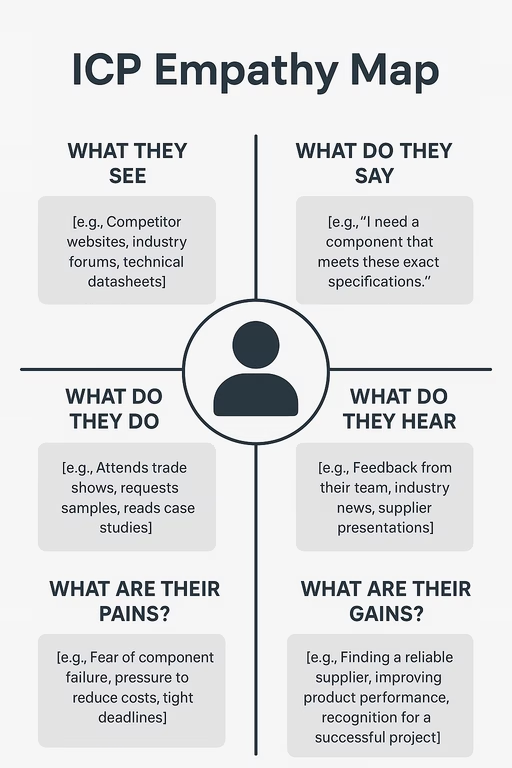
Step 1: Create a Single Source of Truth – Your ICP Empathy Map
To create content that resonates, you must first understand your customer’s world. An ICP (Ideal Customer Profile) Empathy Map is a collaborative tool for capturing your customer’s pains, gains, and jobs-to-be-done. This document, created and shared by your sales, marketing, and engineering teams, becomes the single source of truth for all your content creation efforts.
| Who are we empathizing with? | What do they need to DO? | ||
|---|---|---|---|
| [Role, e.g., Senior Design Engineer] | [Primary Goal, e.g., Source a reliable component for a new product line] | ||
| What do they SEE? | What do they SAY? | What do they DO? | What do they HEAR? |
| [e.g., Competitor websites, industry forums, technical datasheets] | [e.g., “I need a component that meets these exact specifications.”] | [e.g., Attends trade shows, requests samples, reads case studies] | [e.g., Feedback from their team, industry news, supplier presentations] |
| What are their PAINS? | What are their GAINS? | ||
| [e.g., Fear of component failure, pressure to reduce costs, tight deadlines] | [e.g., Finding a reliable supplier, improving product performance, recognition for a successful project] | ||
Key Takeaway: You cannot create compelling content without a deep and shared understanding of your customer’s reality.
Step 2: From Features to Frameworks – The Value Proposition Matrix
The Value Proposition Matrix is your Rosetta Stone for translating technical jargon into compelling customer value. This simple yet powerful tool helps you to systematically map your product’s features to their corresponding advantages and, most importantly, the tangible benefits they deliver to your customers. By forcing you to adopt a customer-centric perspective, this matrix ensures that your content always addresses the question, “What’s in it for me?”
| Feature | Advantage | Benefit |
|---|---|---|
| [e.g., ±0.05% Accuracy] | [e.g., Provides highly precise measurements] | [e.g., Prevents costly production errors and ensures consistent quality] |
| [e.g., IP67 Rating] | [e.g., Dust-tight and can withstand water immersion] | [e.g., Reliable operation in harsh industrial environments, reducing downtime] |
Key Takeaway: The Value Proposition Matrix is the bridge between what your product *is* and what it *does* for your customer.
Step 3: The Content Assembly Line – A Scalable Model for Content Creation
A staggering 54% of marketing teams lack a scalable model for content creation. Instead of perpetually reinventing the wheel, you need to build a “content assembly line” that enables you to repurpose and scale your efforts. This involves creating a “pillar” piece of content, such as a comprehensive white paper or an in-depth blog post, and then strategically breaking it down into smaller “spoke” pieces, such as social media updates, infographics, and email newsletters.
Example Content Repurposing Workflow:
- Pillar Content: 3,000-word blog post on “The Ultimate Guide to Sensor Selection for Industrial Automation.”
- Spoke Content:
- Five short blog posts on specific topics from the guide (e.g., “5 Key Considerations for High-Temperature Environments”).
- An infographic visualizing the sensor selection process.
- A series of social media posts with key takeaways from the guide.
- A webinar expanding on a specific section of the guide.
- An email nurture sequence for leads who download the guide.
Key Takeaway: Stop creating content from scratch. Start building a system to amplify and scale your expertise.
Step 4: Closing the Loop – Shared Metrics That Actually Matter
What gets measured gets managed. To truly align your sales and marketing teams, you must align their metrics. Move beyond vanity metrics like website traffic and lead volume, and instead focus on shared KPIs that are directly tied to revenue, such as Customer Acquisition Cost (CAC), Lifetime Value (LTV), and Sales Cycle Length. When both teams are held accountable for the same revenue-centric goals, they are incentivized to work together as a cohesive unit.
Key Takeaway: If you want to align your teams, align their incentives. Shared revenue goals are the ultimate unifier.
Struggling to prove ROI from your manufacturing content marketing? You’re not alone. Our comprehensive Manufacturing Content Strategy Template cuts through the generic advice to deliver a proven, step-by-step framework designed specifically for the unique challenges of B2B manufacturing companies. Download this free template now and transform your content from a cost center into a revenue-generating asset that drives measurable business results. By leveraging our template, you can align your content efforts with clear business objectives, making it easier to track and demonstrate ROI. This approach not only enhances your brand visibility but also fosters stronger relationships with potential clients, reinforcing the effectiveness of your manufacturing B2B marketing strategies. Start seeing tangible results today and elevate your manufacturing content to new heights.
The GrowthBeaver Advantage: Your Unfair Edge in a Competitive Market
The challenges of achieving sales and marketing alignment in the manufacturing industry are substantial, but they are not insurmountable. GrowthBeaver is a platform meticulously designed to help technical B2B manufacturers like you to bridge the gap between your sales, marketing, and engineering teams. We empower you to understand the broad vertical markets you serve, craft compelling sales narratives, and ultimately, transform your sales organization into a high-performance growth engine.
Conclusion: Stop Building Silos, Start Building a Growth Engine
The antiquated model of siloed sales and marketing departments is no longer viable in today’s fiercely competitive manufacturing landscape. To not just survive but thrive, you must dismantle these internal barriers and construct a unified growth engine fueled by high-quality, customer-centric content. By implementing the four-step blueprint outlined in this article — creating a single source of truth, translating features into value, building a scalable content model, and aligning around shared metrics — you can transform your sales and marketing teams from a source of friction into a formidable revenue-generating powerhouse.
Ready to transform your sales and marketing teams into a revenue-generating powerhouse? Sign up for the GrowthBeaver waitlist and gain exclusive access to our platform.
FAQs
What is sales and marketing alignment?
Sales and marketing alignment is the strategic integration of your sales and marketing functions — including goals, strategies, and technologies — to create a seamless and consistent customer experience from the first touchpoint to the final sale and beyond.
Why is sales and marketing alignment crucial for manufacturing companies?
In the manufacturing sector, where sales cycles are long, products are complex, and trust is paramount, sales and marketing alignment is essential for effectively nurturing leads, communicating value, and closing deals.
How do you measure sales and marketing alignment?
Sales and marketing alignment is best measured by tracking shared, revenue-focused KPIs such as Customer Acquisition Cost (CAC), Lifetime Value (LTV), sales cycle length, and lead-to-customer conversion rate.
What are the initial steps to improving sales and marketing alignment?
The foundational steps to improving sales and marketing alignment include creating a shared ICP empathy map, developing a value proposition matrix, and establishing a regular cadence of communication and collaboration between the two teams.
About the Author: Stephan is a senior engineer with over 15 years of experience selling high-tech components to OEMs globally. Located in Zurich, Switzerland, he is passionate about understanding customer pains and hidden desires.

