

Picture this: Your engineering team just developed a breakthrough sensor technology that outperforms anything on the market. Yet your sales team struggles to communicate its value, and your marketing content gets ignored by the very customers who need it most.
This scenario plays out daily across the manufacturing industry, where 66% of companies struggle with content that converts despite having superior technical products. In an industry projected to add $2.1 trillion in value to the U.S. economy in 2025, the gap between technical excellence and market success is widening. This comprehensive guide provides a strategic framework for manufacturing companies to bridge this divide, transforming engineering precision into compelling customer value and sustainable growth.
The Manufacturing Marketing Reality Check
The $2.1 Trillion Opportunity
The U.S. manufacturing sector is experiencing unprecedented growth, with approximately 623,000 manufacturing businesses positioned to capitalize on a compound annual growth rate of 1.18% in 2025. Manufacturing revenue is expected to grow by 4.2% this year alone, creating substantial opportunities for companies that can effectively communicate their value proposition.
However, this growth comes with intensified global competition. As one sales engineer from a semiconductor manufacturer recently told me, “We’re competing against companies from three different continents for the same automotive contract. Technical superiority isn’t enough anymore—we need to tell our story better.”
Why Traditional Marketing Fails Technical Products
Traditional marketing approaches often fall short in the technical B2B space because they fail to address the unique challenges of selling complex, engineered products. The emphasis on features over customer-centric value, coupled with a disconnect between the engineering mindset and the customer’s business perspective, leads to content that fails to resonate with decision-makers. To effectively engage these decision-makers, it’s crucial to adopt engineeringfocused marketing strategies that prioritize understanding the specific needs and pain points of the customer. By aligning technical details with the overarching business objectives of potential clients, companies can create a more compelling narrative that highlights not just the product’s features, but also its strategic value. This shift in perspective allows for more meaningful conversations that can drive conversions and foster long-term relationships.
Consider the complexity of modern B2B buying committees. A typical industrial automation purchase involves an average of 6.8 stakeholders, each with different priorities and technical knowledge levels. Your content must speak to the plant engineer’s technical requirements, the procurement manager’s cost concerns, and the operations director’s efficiency goals—all simultaneously.
| Stakeholder | Primary Concern | Content Preference |
|---|---|---|
| Plant Engineer | Technical specifications and reliability | Detailed technical documentation, test data |
| Procurement Manager | Cost optimization and supplier reliability | ROI calculations, total cost of ownership |
| Operations Director | Productivity and efficiency gains | Case studies, performance benchmarks |
| Quality Manager | Compliance and risk mitigation | Certifications, regulatory compliance data |
Key Takeaway: Manufacturing companies typically allocate only 1-3% of their revenue to marketing, yet those with strong sales and marketing alignment achieve up to 208% more revenue growth.
The Technical Sales-Marketing Alignment Crisis
The Communication Breakdown
A staggering 57% of B2B buyers make their purchasing decisions before ever speaking to a sales representative. This shift in buyer behavior underscores the critical need for marketing to effectively communicate technical value. However, a persistent communication breakdown between technical sales teams and marketing departments often results in misaligned messaging and missed opportunities.
The root of this problem lies in language barriers—not linguistic ones, but conceptual ones. Engineers speak in specifications, tolerances, and performance metrics. Marketers speak in benefits, value propositions, and customer outcomes. Customers speak in problems, constraints, and business objectives. Without a common translation framework, these three languages rarely align.
I’ve witnessed this firsthand while working with a valve manufacturer whose engineering team had developed a revolutionary flow control technology. The engineers were excited about the 0.1% accuracy improvement over competitors. The marketing team promoted “industry-leading precision.” But customers were asking, “How does this help me reduce waste in my chemical process?” The disconnect was costing them deals.
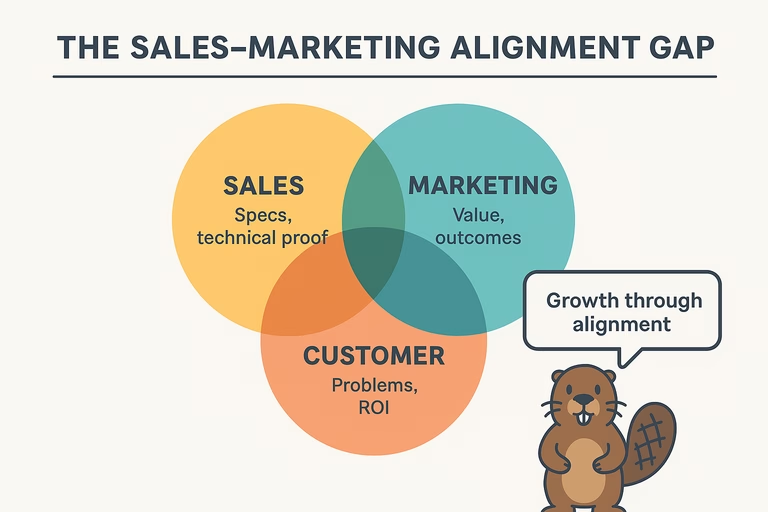
The Cost of Misalignment
The consequences of sales-marketing misalignment extend far beyond missed opportunities. Research from Marketing Charts reveals that companies with poor alignment experience 4% revenue decline annually, while aligned organizations achieve 20% growth rates. In addition to financial repercussions, sales and marketing misalignment issues can lead to decreased employee morale and productivity, as teams may feel frustrated by conflicting goals and lack of collaboration. This discord can also result in a fragmented customer experience, making it difficult for companies to provide cohesive messaging and service. Ultimately, addressing these challenges is essential for fostering a unified approach that drives sustained growth and customer satisfaction.
In manufacturing, where sales cycles can extend 12-18 months and deal values often reach six or seven figures, the cost of misalignment compounds quickly. A single misqualified lead can consume weeks of engineering time in technical discussions that never convert. Multiply this across dozens of opportunities, and the resource waste becomes staggering.
The SME Challenge
Small and medium-sized enterprises (SMEs) face unique challenges in achieving sales-marketing alignment. With limited resources and personnel often wearing multiple hats, these companies must be exceptionally strategic about their marketing investments. The good news? SMEs can often move faster than larger competitors, implementing alignment strategies in weeks rather than months.
Key Takeaway: Companies with strong sales and marketing alignment achieve a 20% average annual growth rate, while their misaligned counterparts see a 4% decline.
Struggling with sales-marketing alignment? Get early access to GrowthBeaver’s alignment framework designed specifically for technical manufacturing companies.
The Customer Journey Revolution in Manufacturing
Modern B2B Buyer Behavior
The modern B2B buyer is more informed and independent than ever before. Research shows that 40% of B2B buyers consume three to five pieces of content before they are willing to engage with a salesperson. For technical products, this number often climbs higher as buyers seek to validate complex specifications and integration requirements. As a result, companies must adopt effective value selling strategies for B2B to cater to these self-guided buyers. By providing valuable content that aligns with their needs, businesses can establish trust and authority in their respective industries. Ultimately, understanding the buyer’s journey is crucial for tailoring outreach efforts and maximizing conversion rates.
This digital-first approach means your online presence serves as your most important sales tool. Technical buyers conduct extensive research to validate solutions, compare alternatives, and build internal business cases—all before your sales team knows they exist.
Mapping the Technical Buyer’s Journey
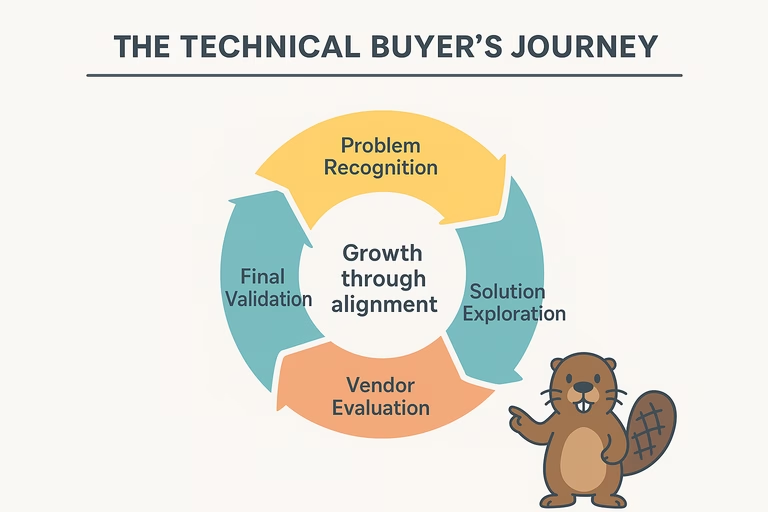
Understanding the technical buyer’s journey requires recognizing that it’s not linear but cyclical, with buyers moving back and forth between stages as they gather information and build consensus within their organizations.
| Journey Stage | Buyer Mindset | Key Questions | Content Strategy |
|---|---|---|---|
| Problem Recognition | Something isn’t working optimally | “What’s causing this inefficiency?” | Educational content, industry benchmarks |
| Solution Exploration | What options are available? | “What technologies could solve this?” | Technology guides, comparison matrices |
| Vendor Evaluation | Who can deliver the best solution? | “Which supplier has the right capabilities?” | Case studies, technical specifications |
| Business Case Building | How do I justify this investment? | “What’s the ROI and risk profile?” | ROI calculators, risk assessments |
| Final Validation | Is this the right decision? | “What could go wrong?” | References, guarantees, pilot programs |
Content Strategy for Each Stage
A successful content strategy provides the right information at each stage of the buyer’s journey, but it must also account for the technical nature of manufacturing purchases. Unlike consumer products, technical buyers need deep, detailed information to make informed decisions. To effectively capture the attention of these buyers, content marketing strategies for tech firms should prioritize thorough analyses, case studies, and product demonstrations that delve into the specifics of their offerings. By providing comprehensive insights and addressing potential challenges, firms can build trust and credibility in an environment where decision-makers require assurance before committing to a purchase. Ultimately, a well-crafted approach that considers the buyer’s technical needs will facilitate smoother sales processes and foster long-term relationships.
During the problem recognition stage, educational content such as industry reports and benchmarking studies help buyers understand the scope and impact of their challenges. White papers that explore root causes and quantify problems are particularly effective.
In the solution exploration phase, buyers need comprehensive guides that explain different technological approaches, their trade-offs, and application considerations. This is where your technical expertise becomes a competitive advantage—you can provide insights that generic marketing agencies simply cannot.
The vendor evaluation stage requires proof of capability through detailed case studies, technical specifications, and performance data. Buyers want to see evidence that you’ve solved similar problems for similar companies under similar conditions.
Key Takeaway: Technical buyers spend as much as 67% of their purchase journey conducting independent online research before they ever engage with a sales team.
The Application-Specific Marketing Framework
Beyond Product Features
To truly connect with technical buyers, manufacturers must move beyond a feature-focused marketing approach. The most successful technical companies I’ve worked with don’t just sell products—they sell solutions to specific applications within specific industries.
Consider a pressure sensor manufacturer. Instead of simply promoting “high accuracy and reliability,” they create separate marketing tracks for automotive brake systems, industrial hydraulics, and medical devices. Each application has unique requirements, regulations, and success metrics. The automotive version emphasizes functional safety standards and temperature cycling. The medical version focuses on biocompatibility and FDA compliance. The industrial version highlights durability and maintenance intervals.
Value Translation Methodology
The core of effective technical marketing is the ability to translate technical capabilities into tangible customer benefits. This value translation methodology involves a systematic three-step process that I’ve refined through years of technical sales experience:
Step 1: Technical Capability Identification – What does your product actually do? Be specific about performance parameters, operating conditions, and technical specifications.
Step 2: Application Context Mapping – How is this capability applied in the customer’s specific use case? What role does it play in their larger system or process?
Step 3: Business Value Quantification – What measurable business outcome does this create? How does it impact productivity, quality, cost, or risk?
For example, a servo motor’s “0.01-degree positioning accuracy” (technical capability) enables “precise pick-and-place operations in electronics assembly” (application context) resulting in “99.9% first-pass yield and $50,000 annual savings in rework costs” (business value).
Market Expansion Strategy
An application-specific marketing approach opens up new opportunities for market expansion that many manufacturers overlook. By systematically analyzing how your core technology can be applied across different industries, you can identify untapped market segments with minimal product development investment.
I recently worked with a motion control company that had built their business serving packaging machinery. By applying the same core technology to medical device manufacturing, they discovered a market segment with 3x higher margins and less price sensitivity. The key was understanding that medical device manufacturers valued precision and reliability over cost optimization—a completely different value proposition requiring different marketing messages.
Content Creation for Technical Audiences
Content for technical audiences must be both informative and credible. Generic marketing content immediately signals to engineers that you don’t understand their world. Technical buyers can spot marketing fluff from a mile away, and they’ll dismiss your entire value proposition if your content lacks technical depth.
The most effective content formats for technical audiences include detailed application notes that show real-world implementation examples, comprehensive white papers that explore technical trade-offs and design considerations, video demonstrations that showcase actual product performance under realistic conditions, and case studies that provide specific performance data and measurable outcomes.
Key Takeaway: Manufacturing companies that create application-specific content see 3x higher engagement rates and can shorten their sales cycles by up to 40%.
Want to create application-specific content that converts? Join GrowthBeaver’s waitlist for access to industry-specific content templates and frameworks.
Digital Transformation in Manufacturing Marketing
Technology Adoption Trends
The manufacturing industry is experiencing a digital transformation that extends far beyond the factory floor. A remarkable 83% of manufacturers believe that smart factories will fundamentally change production within the next five years. This transformation is reshaping marketing as well, with AI and automation playing increasingly important roles in personalizing customer experiences and improving operational efficiency.
However, technology adoption in manufacturing marketing lags behind other industries. While consumer brands have embraced sophisticated marketing automation and AI-driven personalization, many manufacturers still rely on static websites and generic email campaigns. This represents both a challenge and an opportunity for forward-thinking companies.
Content Marketing Performance
Despite the digital transformation, certain content formats continue to dominate in manufacturing marketing. Webinars are considered the most effective strategy for generating high-quality leads by 73% of B2B marketers, while 70% believe that video content is crucial for converting leads.
The effectiveness of webinars in manufacturing makes perfect sense when you consider the technical nature of the products. A live webinar allows for real-time Q&A, detailed technical demonstrations, and the kind of deep-dive discussions that technical buyers crave. It’s the closest thing to having your best sales engineer present to every prospect simultaneously.
Email marketing also continues to be a strong performer, with 18% of manufacturing marketers identifying it as their most effective digital marketing strategy. The key is segmentation and personalization based on industry, application, and technical requirements.
SEO and Digital Presence
A strong digital presence is essential for reaching technical buyers who increasingly begin their research online. Search engine optimization (SEO) is particularly important, with 68% of manufacturing companies using link building as part of their SEO strategy.
However, manufacturing SEO requires a different approach than consumer marketing. Technical buyers use highly specific search terms that often include part numbers, specifications, and industry jargon. Long-tail keywords like “IP67 rated pressure transmitter for hydraulic systems” may have low search volume but extremely high conversion rates.
Measuring Success: ROI and Attribution
The Attribution Challenge
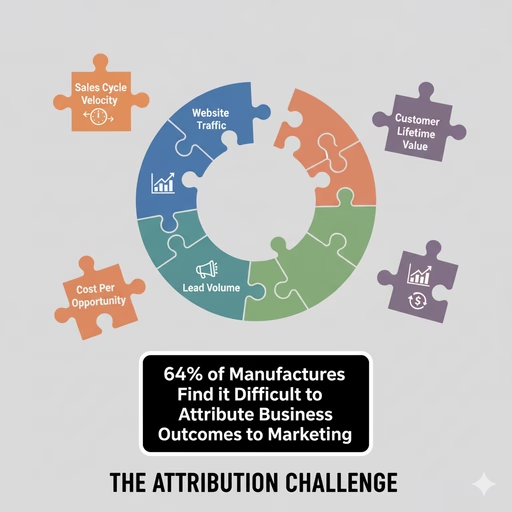
One of the biggest challenges in manufacturing marketing is proving return on investment (ROI). A significant 64% of manufacturers find it difficult to attribute business outcomes to their marketing efforts. This challenge is compounded by the complex and lengthy B2B customer journey, with its multiple touchpoints spanning months or even years.
The attribution problem is particularly acute in manufacturing because of the high-value, low-volume nature of many sales. A single customer might represent millions in revenue over several years, but their journey might include dozens of touchpoints across multiple channels and stakeholders. Traditional attribution models break down under these conditions.
Key Performance Indicators
To overcome the attribution challenge, manufacturers must focus on KPIs that are more closely tied to business outcomes than traditional marketing metrics. Instead of just tracking website traffic and leads, successful manufacturing marketers focus on lead quality, sales cycle length, customer acquisition cost (CAC), and customer lifetime value (CLV).
| Traditional Metric | Manufacturing-Focused Alternative | Why It Matters |
|---|---|---|
| Website Traffic | Qualified Visitor Engagement | Technical buyers research extensively; engagement depth matters more than volume |
| Lead Volume | Sales-Qualified Lead Rate | Manufacturing sales teams have limited capacity; lead quality is critical |
| Cost Per Lead | Cost Per Opportunity | True cost should be measured against sales-qualified opportunities |
| Conversion Rate | Sales Cycle Velocity | Faster qualification and progression matter more than initial conversion |
Tools and Technologies
The right tools and technologies are essential for effective marketing measurement in manufacturing. Customer relationship management (CRM) systems, marketing automation platforms, and analytics tools must be integrated to provide a unified view of the customer journey.
However, many manufacturing companies make the mistake of implementing tools without first defining their measurement strategy. The result is data-rich but insight-poor reporting that doesn’t drive decision-making. Start with the questions you need to answer, then select tools that can provide those answers.
Building Your Manufacturing Marketing Engine
Team Structure and Roles
Building a successful manufacturing marketing engine requires a team structure that bridges technical and commercial expertise. The most effective teams I’ve worked with include technical content specialists who can create credible content for engineering audiences, sales-marketing hybrid roles that ensure alignment and communication, and customer success integration that provides valuable insights into customer needs and pain points.
In smaller organizations, these roles might be combined, but the functions remain essential. A technical marketer who understands both the product capabilities and customer applications can be worth their weight in gold.
Process Development
A well-defined process is essential for consistent and effective marketing. This includes a content creation workflow that ensures a steady stream of high-quality, technically accurate content, a sales enablement program that provides the sales team with the tools and resources they need to be successful, and a customer feedback loop that allows continuous improvement of products and marketing messages.
The feedback loop is particularly important in manufacturing, where customer applications often reveal new use cases and market opportunities. Your sales team is a goldmine of market intelligence—make sure you have processes to capture and act on their insights.
Technology Stack
The right technology stack can significantly enhance your marketing efforts, but it must be tailored to the unique needs of manufacturing marketing. Essential components include a CRM system that can handle complex, multi-stakeholder sales processes, marketing automation that can nurture leads over extended timeframes, and analytics platforms that can track performance across long sales cycles.
When selecting a technology stack, consider integration capabilities, scalability, and the technical sophistication of your team. The best system is the one that gets used consistently, not necessarily the most feature-rich option.
Regulatory Considerations and Compliance
Manufacturing marketing must navigate complex regulatory environments that vary by industry and geography. Companies serving automotive, aerospace, medical device, or pharmaceutical markets face strict compliance requirements that impact everything from product claims to content distribution.
Smart manufacturers turn regulatory compliance into a competitive advantage by demonstrating deep understanding of industry requirements. Content that addresses regulatory considerations, compliance pathways, and risk mitigation strategies resonates strongly with technical buyers who must justify their decisions to regulatory bodies.
The Future of Manufacturing Marketing
Looking ahead, several trends will shape the future of manufacturing marketing. Artificial intelligence will enable more sophisticated personalization and predictive analytics, but it will never replace the need for deep technical knowledge and industry expertise. Sustainability and environmental considerations will become increasingly important in B2B purchasing decisions. Digital twins and virtual reality will enable new forms of product demonstration and customer engagement.
The companies that thrive will be those that combine technological innovation with fundamental marketing principles: understanding customer needs, communicating value clearly, and building trust through expertise and reliability.
Conclusion
The manufacturing industry stands at a critical juncture. While the opportunities for growth are immense—with $2.1 trillion in projected value creation—success hinges on the ability to bridge the gap between technical expertise and market-ready messaging. The strategies outlined in this guide provide a roadmap for building a powerful marketing engine that drives sustainable growth and profitability.
The key insights are clear: align your sales and marketing teams around shared definitions and goals, create application-specific content that speaks to real customer needs, leverage digital transformation while maintaining technical credibility, and measure what matters for long-term business success. Companies that master these fundamentals will not only survive but thrive in the competitive landscape of 2025 and beyond.
Remember, in manufacturing marketing, authenticity beats sophistication every time. Your customers are smart, experienced professionals who can spot marketing fluff immediately. Lead with expertise, support with data, and always connect technical capabilities to business outcomes. By focusing on clarity and straightforward communication, you build trust and credibility with your audience. Implementing effective content marketing strategies for engineers will further enhance your ability to engage this discerning group. Prioritize valuable insights and real-world applications to demonstrate how your solutions can drive tangible results in their projects.
Frequently Asked Questions (FAQ)
How do I align technical sales teams with marketing objectives?
Successful alignment requires shared definitions of qualified leads, joint goal setting, regular communication cadences, and integrated technology platforms that provide visibility into the entire customer journey. Start with weekly alignment meetings and shared KPIs that both teams can influence.
What content types work best for manufacturing B2B marketing?
Technical buyers respond best to application-specific content including white papers, case studies, video demonstrations, webinars, and detailed product specifications that show real-world implementation examples. The key is providing enough technical depth to establish credibility while connecting features to business outcomes. Offering insights into how to write technical white papers can further enhance engagement by guiding buyers on best practices. Additionally, including testimonials and expert opinions within these resources can solidify trust and authority in the information presented. Ultimately, a well-rounded approach that combines content types will resonate more profoundly with the technical audience.
How can SMEs compete with larger manufacturing companies?
Small and medium enterprises can compete by focusing on niche applications, providing superior customer service, leveraging agility for faster innovation, and creating highly targeted content for specific market segments. SMEs often have advantages in customization and responsiveness that larger competitors cannot match.
What is the ROI timeline for manufacturing marketing investments?
The ROI timeline for manufacturing marketing varies depending on sales cycle length and product complexity. However, companies with aligned sales and marketing teams typically see significant returns within 12 to 18 months. Early indicators of success include improved lead quality and shortened sales cycles, which can be measured within 3-6 months.
How do I identify new applications for existing products?
Identifying new applications requires systematic analysis of your core technology capabilities, customer interviews to understand adjacent needs, market research to identify similar applications in different industries, and collaboration between sales, engineering, and marketing teams to spot patterns and opportunities.
What budget should I allocate to manufacturing marketing?
While the industry average is 1-3% of revenue, high-growth manufacturing companies often invest 3-5% in marketing. The key is to start with a clear strategy and measurable goals, then scale investment based on proven ROI. Focus on quality over quantity—better to do fewer things well than many things poorly.
Ready to transform your technical expertise into market success? Manufacturing companies using GrowthBeaver’s application-specific marketing framework report 40% shorter sales cycles and 3x higher engagement rates. Join our waitlist to get exclusive access to tools and resources designed specifically for technical sales professionals.
About the Author
Stephan is a senior engineer with over 15 years of experience selling high-tech components to OEMs globally. Based in Zurich, Switzerland, he specializes in understanding customer pain points and translating technical capabilities into compelling value propositions. His experience spans sensors, actuators, drives, and semiconductor components across automotive, industrial automation, and medical device markets.
References
- WebFX – 20 Manufacturing Marketing Statistics & Trends in 2025
- NPWS – Manufacturing Marketing Challenges of 2025
- Demandbase – B2B Sales & Marketing Alignment: 7 Strategies for Growth
- Forrester – The Truth About B2B Sales And Marketing Alignment
- Evenbound – 7 B2B Marketing & Sales Alignment Strategies for Industrial Companies
- Content Marketing Institute – Manufacturing Content Marketing Research
- Marketing Charts – Improved B2B Marketing and Sales Alignment

