

Your technical specs are impressive. Your content converts at 2%. Here’s why – and how to fix it.
A staggering 66% of manufacturers report that their content fails to convert prospects into leads [1]. This isn’t a failure of product engineering or marketing effort; it’s a failure of empathy. Engineering-heavy organizations often create feature-focused content that meticulously details technical specifications while completely ignoring the customer’s actual problems. A valve manufacturer might proudly showcase its pressure ratings and material certifications, while the customer is desperately searching for a solution to prevent unplanned production shutdowns. An electronics OEM might list every technical parameter of their sensor, while the buyer needs to understand how it will reduce quality control failures in their assembly line.
The consequences of this disconnect are severe and measurable. Without a systematic approach to getting customer pain point analysis for content, manufacturers waste precious resources on marketing materials nobody reads, lose deals to competitors who demonstrate a deeper understanding of the buyer’s needs, and struggle to prove the return on investment of their marketing efforts. The data reveals that 64% of manufacturers have difficulty proving ROI, 43% struggle to differentiate their offerings, and 57% cite lack of resources as their biggest challenge [1]. These are not isolated problems; they are symptoms of a fundamental misalignment between what manufacturers communicate and what customers actually need to hear.
This comprehensive guide provides a systematic pain point analysis framework specifically designed for resource-constrained technical B2B teams. Research from the Content Marketing Institute in 2025 shows that customer understanding (40%) is a more significant driver of marketing effectiveness than the technology and tools used (43%) [2]. This finding validates what successful manufacturers have known for years: the best content doesn’t start with your product catalog; it starts with your customer’s problems. By the end of this article, you will have actionable frameworks, ready-to-use templates, and time-efficient processes to transform your content from a dry recitation of features into a high-converting engine for growth.
Why Most Manufacturing Content Fails (And Why Pain Points Are the Answer)
The data paints a clear picture of the manufacturing sector’s content marketing struggles. Beyond the 66% of manufacturers who state their content doesn’t convert, 64% have difficulty proving ROI, and 43% struggle to differentiate their offerings from the competition [1]. The common thread is a disconnect from the customer’s perspective. This often manifests as “feature dumping”—a content strategy that lists technical specifications without explaining how those features solve a real-world business problem. For example, an industrial sensor manufacturer might boast about its product’s IP67 rating, but a potential customer is more interested in a solution that prevents costly downtime from equipment failure in wet environments.
Key Takeaway: Content relevance and quality drive 65% of marketing effectiveness—but you can’t be relevant without understanding customer pain points first [2].
Shifting from a product-centric to a problem-solving mindset is the first step toward creating content that resonates. This requires a deep understanding of what your customers are trying to achieve, the obstacles they face, and the language they use to describe their challenges. Download our pain point discovery template to start identifying the core problems your content should address.
What Customer Pain Points Actually Are (And Why They Matter for Technical Products)
Customer pain points are specific problems, frustrations, or unmet needs that a potential customer experiences. For technical B2B products, these pains are often multifaceted, spanning financial, operational, and technical challenges. Understanding these categories is crucial for creating content that speaks directly to the buyer’s context.
The Four Core Pain Point Categories
Most B2B pain points can be grouped into four primary categories, a framework adapted from research by sources like Cognism [3]:
- Financial Pain Points: These relate to the customer’s budget and financial efficiency. For a manufacturer, this could be the high cost of production downtime, the expense of regulatory non-compliance, or the desire for a lower total cost of ownership from their equipment.
- Productivity Pain Points: These are frustrations related to wasted time or inefficient processes. A technical buyer might be struggling with a slow, manual quality control process or a machine that requires frequent, time-consuming calibration.
- Process Pain Points: These arise from clunky, complicated, or unclear workflows. This could be a convoluted procurement process for spare parts or a difficult-to-navigate software interface for a new piece of machinery.
- Support Pain Points: These involve a lack of adequate help or guidance. For complex technical products, this is a major concern, such as slow response times for critical equipment repairs or a lack of clear documentation for a new sensor.
The Hidden Fifth Category: Technical Pain Points
For B2B manufacturers and OEMs, a fifth category is critical: Technical Pain Points. These are the specific technical challenges that prevent a customer from achieving their goals:
- Integration Challenges: The difficulty of getting a new component to work with an existing system.
- Compatibility Concerns: The fear that a new piece of equipment won’t be compatible with legacy software or hardware.
- Implementation Complexity: The time and expertise required to get a new solution up and running.
- Learning Curves: The difficulty for a team to learn and adopt a new technology.
The following table illustrates how different pain points can be addressed with specific content formats:
| Pain Point Category | Manufacturing Example | Recommended Content Format |
|---|---|---|
| Financial | “Our energy costs for running the production line are too high.” | ROI Calculator, Total Cost of Ownership (TCO) Comparison Guide |
| Productivity | “We waste too much time on manual inspections.” | Case Study on Automated Inspection, How-To Guide for Process Optimization |
| Process | “The process for ordering custom-machined parts is too slow.” | Implementation Checklist, Step-by-Step Ordering Guide |
| Support | “We can’t get quick answers when a machine goes down.” | 24/7 Support Guide, Video Troubleshooting Series, Comprehensive FAQ |
| Technical | “We’re not sure if your valve will integrate with our existing control system.” | Integration Guide, Compatibility Matrix, Technical Documentation |
Key Takeaway: Technical B2B buyers don’t search for ‘high-precision sensors’—they search for ‘how to reduce quality control failures in electronics assembly.’ Your content needs to speak their language of problems, not your language of products.
The 5-Step Pain Point Analysis Framework for Technical B2B Manufacturers
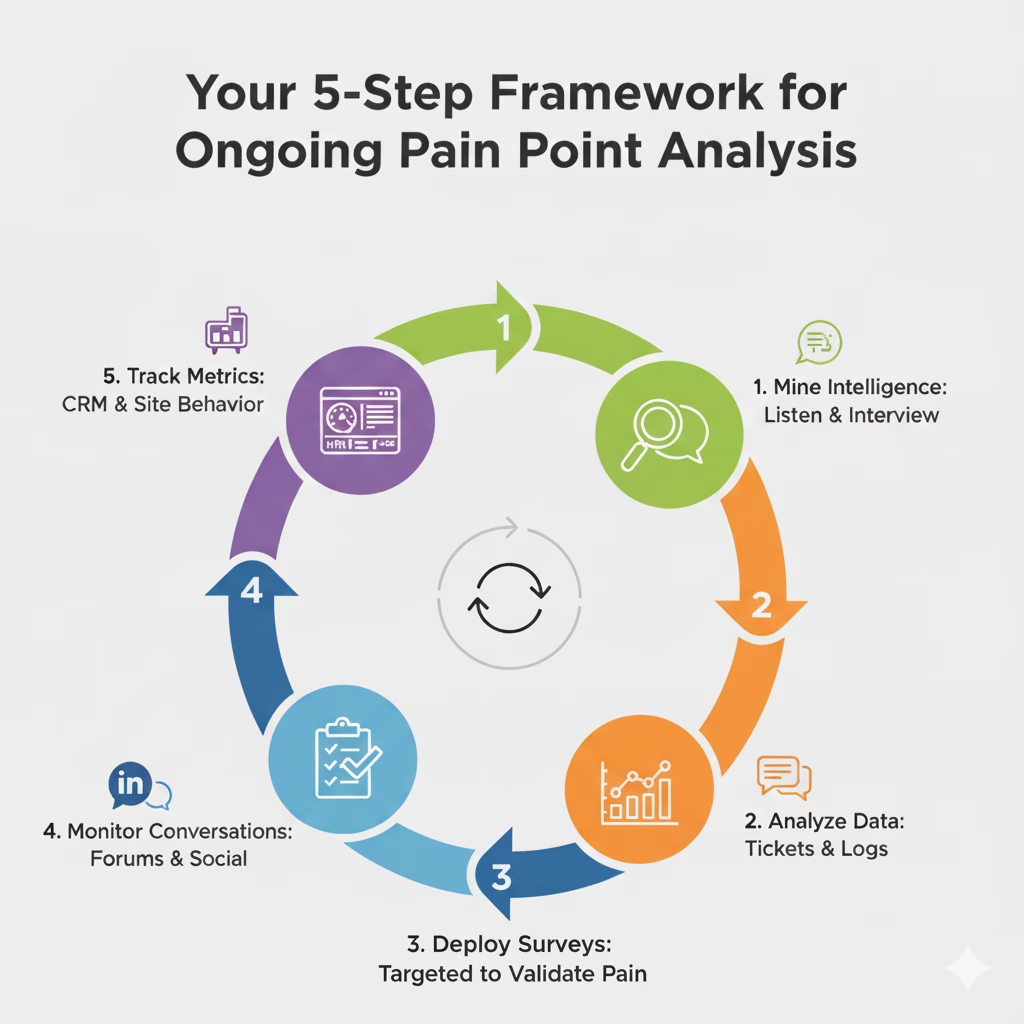
A systematic approach to pain point analysis is not a massive, one-time research project. It’s an ongoing business process that can be managed with limited resources. This 5-step framework, adapted from methodologies outlined by sources like Data-Mania [4], is designed for the realities of lean manufacturing teams.
Step 1: Mine Your Existing Intelligence (Customer Interviews & Sales Conversations)
The fastest way to uncover pain points is to listen to the people who are already talking to your customers. Your sales and customer service teams are a goldmine of information. Schedule brief, regular check-ins with your sales engineers and account managers to ask them about the challenges and objections they hear most often. For a more structured approach, conduct formal customer interviews. These conversations provide the raw, unfiltered language your customers use to describe their problems, which is invaluable for creating authentic and relatable content.
Sample Discovery Questions for Technical Sales Engineers:
- “What problem were you trying to solve when you started looking for a solution like ours?”
- “What’s the biggest challenge you’re facing with your current setup?”
- “What would happen if you didn’t solve this problem?”
- “How much time/money is this problem costing you?”
- “What have you tried before, and why didn’t it work?”
- “What concerns do you have about implementing a new solution?”
- “Who else in your organization is affected by this problem?”
- “What would success look like for you six months after implementation?”
These questions are designed to move beyond surface-level feature discussions and uncover the deeper business and operational challenges your customers face. Pay close attention to the exact words and phrases they use—this language should be directly incorporated into your content.
Time Investment: 2-3 hours/week
Tools Needed: CRM, note-taking system (e.g., Notion, Evernote)
Step 2: Analyze Support & Service Data
Your help desk is a real-time database of customer pain points. Regularly review support tickets, email inquiries, and chat logs to identify recurring issues. Categorize these issues to spot trends. Are customers frequently asking about the integration of a particular component? Are there common complaints about the usability of your product’s software? This data provides quantitative evidence of the most frequent and severe pain points your customers face.
Time Investment: 1-2 hours/week
Tools: Help desk software (e.g., Zendesk, Jira Service Management), Excel/Google Sheets
Step 3: Deploy Targeted Surveys
While interviews provide depth, surveys provide breadth. Use short, targeted surveys to validate the pain points you’ve identified in steps 1 and 2 across a wider customer base. Keep surveys brief—5 to 7 minutes is ideal—and use a mix of multiple-choice and open-ended questions. Ask customers to rank their challenges or rate the severity of specific problems. This will help you prioritize your content efforts on the issues that matter most to the largest number of customers.
Time Investment: 1 hour setup, 30 min/quarter for analysis
Tools: Google Forms, Typeform, SurveyMonkey
Step 4: Monitor Social & Industry Conversations
Your customers are talking about their challenges online, even if they’re not talking directly to you. Monitor LinkedIn groups, industry forums (like those on Reddit or specialized engineering communities), and competitor social media mentions to understand the broader conversation in your market. This is an excellent way to pick up on emerging trends and capture the candid language your audience uses to describe their problems.
Time Investment: 30 minutes/week
Tools: LinkedIn, industry forums, Hootsuite/Sprout Social (optional)
Step 5: Track Sales Metrics & Customer Behavior
Your sales and website data can reveal hidden pain points. A high churn rate among new customers might indicate a difficult onboarding process. A long sales cycle for a particular product could signal that your content isn’t adequately addressing key objections. Analyze lost deal reasons in your CRM and look at the user behavior on your website. Which pages have high exit rates? What are people searching for on your site? This data provides behavioral evidence of where your customers are struggling.
Time Investment: 1 hour/month
Tools: CRM, Google Analytics, marketing automation platform
Key Takeaway: The most effective manufacturers combine all five methods and conduct research every 6-12 months—not as a one-time project, but as an ongoing intelligence system.
Translating Technical Features Into Pain Point Solutions
One of the biggest hurdles for engineering-driven companies is the tendency to lead with technical specifications. While these details are important, they are not what initially captures a buyer’s interest. Customers are looking for solutions to their problems, not a list of features. The key is to translate your product’s technical attributes into tangible value propositions that address specific pain points.
The Feature-to-Value Translation Framework
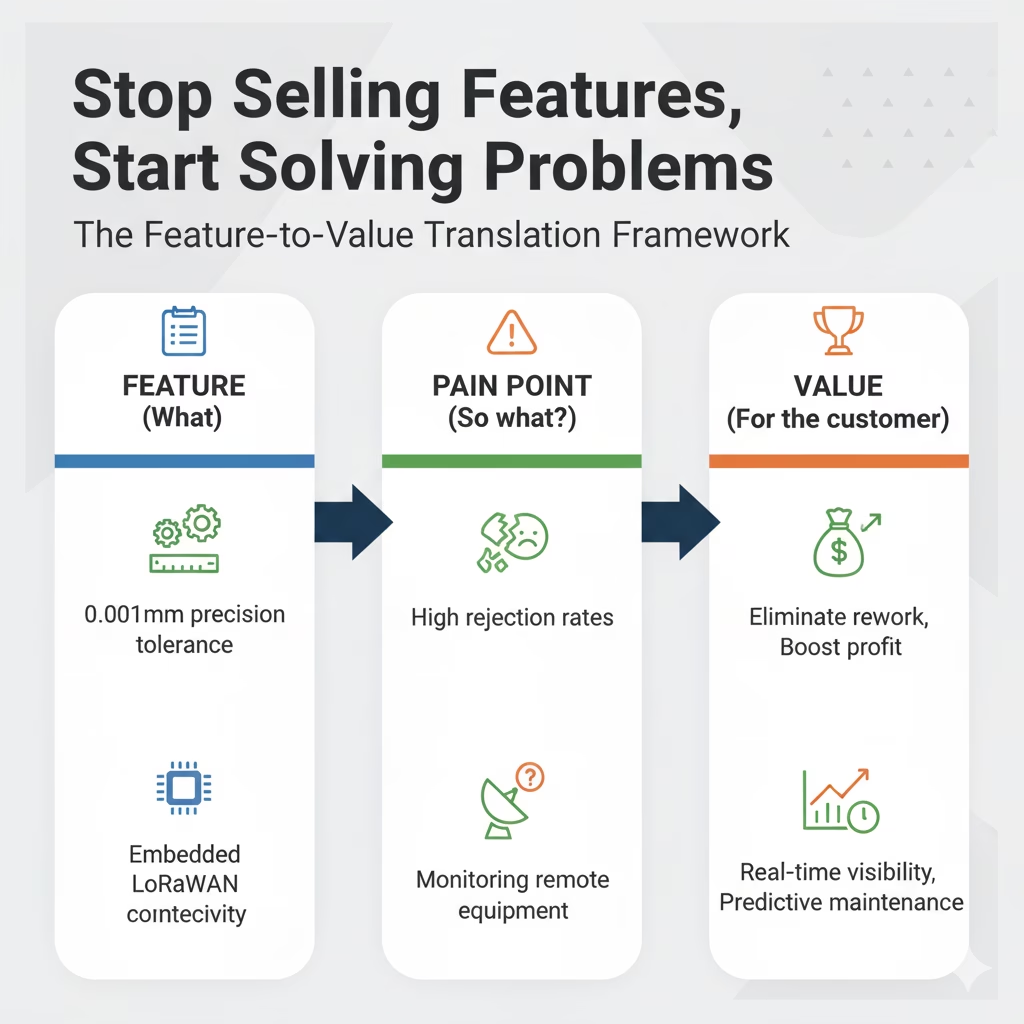
This simple framework can help your team bridge the gap between engineering and marketing. For each key feature of your product, work through the following three steps:
- Identify the Feature: State the technical specification in clear, simple terms (e.g., “Our actuator has a certified IP69K rating.”).
- Connect to the Pain Point: Ask “So what?” to connect that feature to a specific customer problem (e.g., “This means it can withstand high-pressure, high-temperature washdowns.”).
- Articulate the Value: Explain the tangible business outcome or benefit that the customer receives (e.g., “This eliminates the risk of equipment failure and costly downtime in food processing environments that require frequent, intensive cleaning.”).
Here is a table to guide this process:
| Feature (What it is) | Pain Point Addressed (So what?) | Value (What it means for the customer) |
|---|---|---|
| 0.001mm precision tolerance on a CNC machine | Struggling with high rejection rates on complex parts | Eliminate costly rework and improve profitability on high-value components |
| Embedded LoRaWAN connectivity in a sensor | Difficulty monitoring equipment in remote or hard-to-reach locations | Gain real-time visibility into asset performance and enable predictive maintenance, reducing the risk of unexpected failures |
Creating Pain Point-Based Product Positioning
This framework should be the foundation of your product messaging. Instead of leading with a headline like “Introducing the Series 5 Industrial Valve,” lead with a pain point: “Tired of Production Halts from Valve Failures?” This immediately signals to the prospect that you understand their problem. Your product pages, sales presentations, and marketing materials should all be structured to introduce the problem first, then present your product as the solution.
Key Takeaway: Your product’s 0.001mm precision tolerance isn’t a benefit—it’s a feature. The benefit is ‘eliminate costly rework from dimensional failures in medical device assembly.’
From Pain Points to Content Strategy: The Mapping Process
Once you have a clear understanding of your customers’ pain points, the next step is to translate that intelligence into a concrete content strategy. A 2025 report from New Perspective found that 53% of manufacturers can’t tie their content to business goals, largely because they start with topics, not problems [1]. A pain point mapping process reverses this, ensuring that every piece of content you create is designed to solve a specific customer problem.
Content Format Selection Based on Pain Point Type
The type of pain point should dictate the format of your content. A customer with a financial pain point needs a different kind of information than a customer with a technical one. Use this table as a guide:
| Pain Point Type | Content Format |
|---|---|
| Financial | ROI Calculators, Total Cost of Ownership (TCO) Guides, Pricing Comparison Sheets |
| Productivity | How-To Guides, Process Optimization Checklists, Best Practice Articles |
| Process | Implementation Guides, Step-by-Step Walkthroughs, Onboarding Videos |
| Support | Comprehensive FAQs, Troubleshooting Guides, Knowledge Base Articles |
| Technical | Integration Guides, Compatibility Matrices, Technical Whitepapers, API Documentation |
Buyer Journey Alignment
Pain points also map to different stages of the buyer’s journey. In the awareness stage, customers are just beginning to understand their problem. In the consideration stage, they are evaluating different solutions. In the decision stage, they are ready to choose a vendor. Your content should align with this journey:
- Awareness Stage: Content that helps customers diagnose their problem (e.g., “5 Signs Your Current PLC is Obsolete”).
- Consideration Stage: Content that compares different types of solutions (e.g., “On-Premise vs. Cloud-Based SCADA: Which is Right for You?”).
- Decision Stage: Content that helps customers choose your solution (e.g., “A Detailed Implementation Guide for the XYZ Controller”).
Content Prioritization Framework
With limited resources, you can’t address every pain point at once. Use a simple prioritization matrix to decide where to focus your efforts. Score each potential content idea based on the following criteria:
- Pain Severity (1-5): How significant is this problem for your customers?
- Frequency of Occurrence (1-5): How many customers are affected by this?
- Competitive Gap (1-5): How well are your competitors addressing this pain point?
- Resource Requirements (1-5, low is better): How much time and effort will it take to create this content?
Focus on content that scores high on pain severity, frequency, and competitive gap, and low on resource requirements.
Key Takeaway: 53% of manufacturers can’t tie content to business goals because they start with topics, not problems. Pain point mapping reverses this—every piece of content solves a specific customer problem.
Proving ROI: How to Measure Pain Point-Based Content Effectiveness
A significant challenge for manufacturing marketers is the pressure to demonstrate the financial impact of their efforts. The Content Marketing Institute reports that 40% of B2B marketers cite measurement as a top challenge [2]. When you build your content strategy around customer pain points, however, proving ROI becomes much more straightforward. You can draw a direct line from the problem your content solves to the value it creates for your business.
Attribution Models for Technical B2B
In the complex B2B sales cycle, a simple last-touch attribution model rarely tells the whole story. A multi-touch attribution approach is more effective, as it gives credit to all the content pieces that a prospect interacts with on their journey. By tagging your content by the pain point it addresses, you can start to see which problems are most influential in driving deals forward. You can also measure the influence of your content on deal velocity—does a prospect who reads your TCO guide move through the sales cycle faster than one who doesn’t?
Key Metrics That Matter
Instead of focusing on vanity metrics like page views, track the metrics that demonstrate a real business impact:
- Conversion Rate Improvements: Are more visitors downloading your technical guides or requesting a consultation after you shifted to a pain point-based strategy?
- Sales Cycle Length Reduction: Is your content helping to answer key questions earlier in the process, shortening the time from lead to close?
- Support Ticket Deflection: Are you seeing a decrease in support tickets related to the problems your new content addresses?
- Organic Search Visibility: Are you ranking for the long-tail keywords that your customers use when they are searching for solutions to their problems?
- Lead Quality: Are the leads generated from your pain point-based content more qualified and more likely to close?
Building Your Measurement Dashboard
Create a simple dashboard to track these KPIs. Tools like HubSpot, Google Analytics, and Databox can be configured to report on these metrics. Review this dashboard monthly to understand what’s working and where you need to make adjustments. Share these results with your leadership team to demonstrate the clear connection between your content efforts and the company’s bottom line.
Key Takeaway: When you connect content topics directly to customer pain points, attribution becomes simple: track which pain point content drives conversations, demos, and deals.
Implementation for Lean Marketing Teams: The 30-Minute Weekly Routine
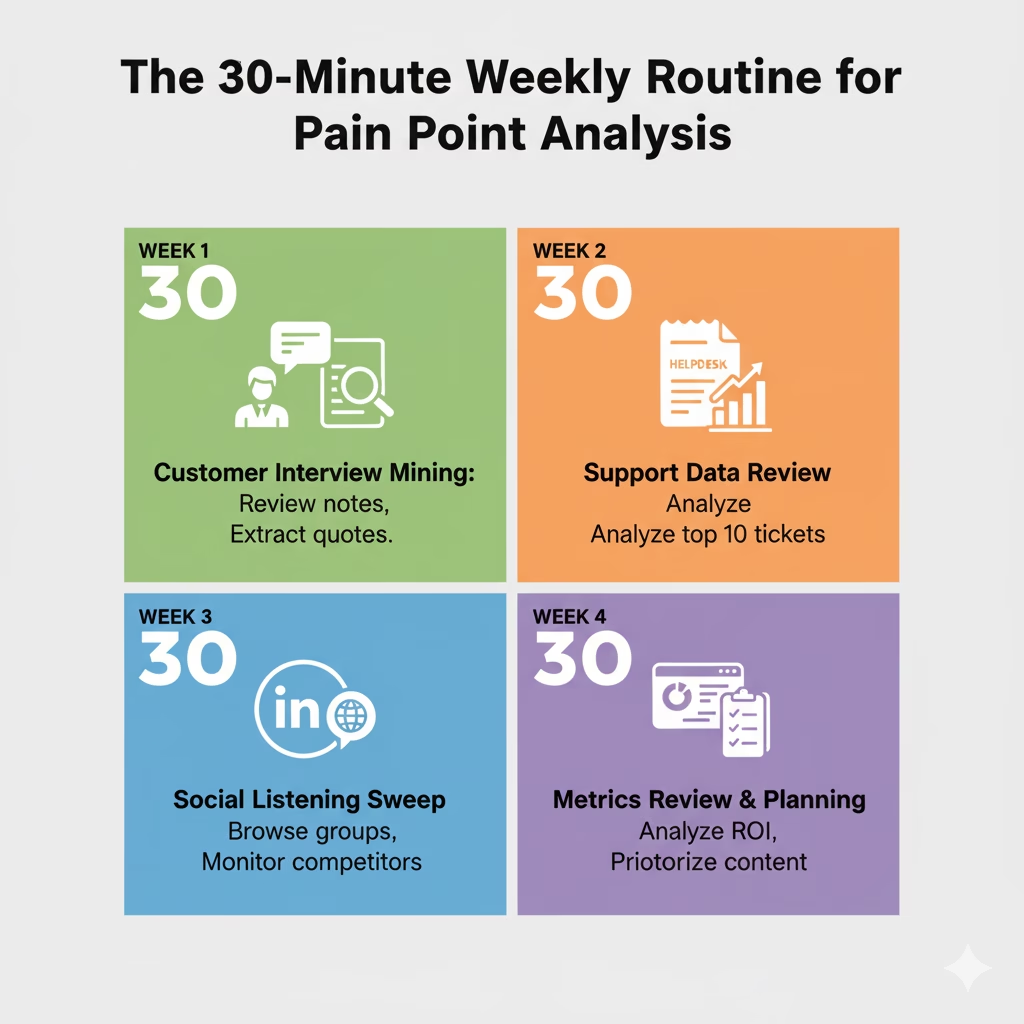
The idea of implementing a comprehensive pain point analysis process can feel daunting, especially for the 57% of manufacturing marketers who cite a lack of resources as their biggest challenge [1]. However, you don’t need a large team or a massive budget to do this effectively. Consistency is more important than intensity. A systematic, 30-minute weekly routine can yield more valuable insights than sporadic, multi-day research projects. Here is a sample four-week rotating schedule:
Week 1: Customer Interview Mining (30 Minutes)
- Review the notes from 2-3 recent sales calls or customer check-ins.
- Extract any direct quotes or mentions of challenges, frustrations, or goals.
- Add these to a centralized pain point repository (a simple spreadsheet will do).
Week 2: Support Data Review (30 Minutes)
- Analyze the top 10 most frequent support ticket categories from the past month.
- Identify any recurring issues or technical questions.
- Note any gaps in your existing knowledge base or FAQ content.
Week 3: Social Listening Sweep (30 Minutes)
- Spend 15 minutes browsing relevant LinkedIn groups and industry forums.
- Spend 15 minutes monitoring mentions of your top 3 competitors.
- Capture the exact language people are using to describe their problems.
Week 4: Metrics Review & Content Planning (30 Minutes)
- Review your pain point content ROI dashboard.
- Identify which content pieces are performing best and which are underperforming.
- Use these insights to prioritize the next 2-3 content pieces for your editorial calendar.
Key Takeaway: You don’t need a large team to do pain point analysis well—you need a systematic routine. 30 minutes per week beats sporadic 8-hour research marathons.
Real-World Case Study: How a Sensor Manufacturer Transformed Content Performance
To illustrate how this framework works in practice, let’s examine a real-world example of a mid-sized industrial sensor manufacturer that implemented a systematic pain point analysis process.
The Challenge
Company Profile: A 150-person manufacturer of industrial sensors for quality control applications, primarily serving electronics assembly and medical device manufacturers. Annual revenue of $45 million with a lean marketing team of three people.
The Problem: Despite having technically superior products, the company’s website traffic was stagnant, content engagement was low, and only 1.8% of website visitors were converting to leads. The sales team reported that prospects often couldn’t understand how their sensors differed from competitors, and the average sales cycle was 9-12 months. Marketing struggled to prove ROI and was constantly fighting for budget.
The Implementation
The marketing team implemented the 5-step pain point analysis framework over a 90-day period:
Month 1: Discovery Phase
The team conducted 15 customer interviews using the discovery question framework, analyzed 200 support tickets from the previous quarter, and deployed a survey to their existing customer base (achieving a 23% response rate). They also spent 30 minutes per week monitoring industry forums and LinkedIn groups.
Key Pain Points Identified:
- Customers struggled to validate sensor accuracy in their specific application before purchase (Technical Pain Point)
- The procurement process was complicated by unclear compatibility information (Process Pain Point)
- Buyers couldn’t justify the higher price point to their management without clear ROI data (Financial Pain Point)
- Post-purchase, customers had difficulty optimizing sensor placement for best results (Support Pain Point)
Month 2: Content Strategy Development
Using the pain point mapping process, the team prioritized content creation based on pain severity and competitive gaps. They created a content calendar focused on the four highest-priority pain points.
Month 3: Content Creation & Launch
The team produced and published four cornerstone pieces of content:
- “How to Validate Sensor Accuracy for Your Application: A Step-by-Step Testing Protocol” (Technical Guide)
- “Sensor Compatibility Matrix: Quick Reference for Common PLC and SCADA Systems” (Technical Documentation)
- “ROI Calculator: The True Cost of Quality Control Failures” (Interactive Tool)
- “Optimal Sensor Placement Guide for Electronics Assembly” (Video Series + PDF)
The Results
After six months of implementing the pain point-based content strategy, the company saw measurable improvements across all key metrics:
| Metric | Before | After 6 Months | Improvement |
|---|---|---|---|
| Website Conversion Rate | 1.8% | 4.2% | +133% |
| Average Sales Cycle | 9-12 months | 6-8 months | -33% |
| Organic Search Traffic | 2,400 visits/month | 5,800 visits/month | +142% |
| Support Tickets (Placement Questions) | 45/month | 18/month | -60% |
| Content-Influenced Pipeline | $1.2M/quarter | $3.8M/quarter | +217% |
Key Lessons
The marketing director shared three critical insights from the process:
- “The language shift was transformative.” By using the exact words customers used to describe their problems, the content resonated immediately. Bounce rates dropped by 40% because visitors immediately recognized their own challenges.
- “Sales became our biggest advocates.” When the sales team saw prospects arriving at demos already educated about the solution, they became enthusiastic supporters of the content strategy. They now actively contribute pain points they hear in the field.
- “The ROI story wrote itself.” With clear attribution from content to pipeline, the marketing team secured a 40% budget increase for the following year. The CFO specifically cited the “data-driven approach to addressing customer needs” as the reason for approval.
This case study demonstrates that even a small team with limited resources can achieve significant results by systematically understanding and addressing customer pain points through content.
Advanced Applications: Using Pain Point Analysis for Market Discovery
A robust pain point analysis process does more than just improve your content; it can become a powerful engine for business innovation. The same insights that fuel your content strategy can also reveal new market opportunities, guide product development, and sharpen your competitive positioning. This is where marketing evolves from a cost center into a strategic driver of growth.
Identifying Adjacent Markets
When you analyze pain points systematically, you will start to notice patterns that extend beyond your core customer base. A challenge that you initially identified in the medical device industry might also be prevalent in aerospace manufacturing. By looking for these cross-industry pain point patterns, you can identify adjacent markets where your existing products can solve a known problem with minimal modification. This is a far more efficient growth strategy than attempting to enter a new market with an unproven solution.
Product Development Insights
Your pain point repository is a direct line into the needs of the market. It can provide invaluable guidance for your product development roadmap. The most frequently cited and severe pain points should be a primary input for feature prioritization. Are customers consistently struggling with the integration of your product? Then a new, simplified integration wizard might be a more valuable development effort than adding another niche feature. This data-driven approach ensures that you are investing your R&D resources in solutions that the market is actively asking for.
Key Takeaway: The same pain point analysis that improves your content can also reveal million-dollar market opportunities hiding in plain sight.

Common Mistakes Technical B2B Manufacturers Make (And How to Avoid Them)
Even with the best intentions, it’s easy to fall into common traps when implementing a pain point analysis process. Here are six of the most frequent mistakes, their consequences, and how to avoid them:
- Assuming you know customer pain points without asking. The most dangerous assumption in marketing is that you know what your customers are thinking. Your internal perspective is biased by your deep product knowledge and your organization’s priorities. A manufacturer of industrial controllers might assume that customers care most about processing speed, when in reality, the biggest pain point is the complexity of the programming interface. The Consequence: You create content that addresses problems your customers don’t have, while ignoring the issues that keep them up at night. The Fix: Always validate your assumptions with direct customer feedback. Start every content planning session by reviewing recent customer conversations, not your product roadmap.
- Conducting pain point research once and never updating it. Markets change, technologies evolve, and customer needs shift. A pain point that was critical two years ago might be solved by new technology today, while new challenges have emerged. The Consequence: Your content becomes increasingly irrelevant, and you miss opportunities to address emerging problems before your competitors do. The Fix: Pain point analysis is not a one-time project; it’s an ongoing process. Use the 30-minute weekly routine outlined in this guide to keep your insights fresh and current.
- Letting engineers write customer-facing content without translation. Your engineers are product experts, and their technical knowledge is invaluable. However, they often communicate in a language that is inaccessible to non-technical buyers or decision-makers. The Consequence: Content that is technically accurate but fails to resonate with the economic buyer or the end user who will actually benefit from solving the pain point. The Fix: Use a two-step process. Have engineers provide technical input and review for accuracy, but let your marketing team translate the features into pain point-solving value propositions using the Feature-to-Value framework.
- Focusing only on product-related pain points, ignoring buying process pain. The challenges your customers face are not limited to the use of your product. They also experience frustration during the research, evaluation, and procurement phases. A complex RFQ process, unclear pricing, or difficulty getting technical specifications can be just as significant as the operational problems your product solves. The Consequence: You lose deals to competitors who make the buying process easier, even if your product is technically superior. The Fix: Map pain points across the entire buyer journey, from initial research to post-purchase support. Create content that addresses process pain points like “How to Evaluate Industrial Sensors: A Buyer’s Checklist” or “Understanding Total Cost of Ownership for Pneumatic Actuators.”
- Creating content for pain points that don’t align with your solution. It’s tempting to create content around popular industry pain points to drive traffic. However, if your product can’t actually solve that problem, you’re setting yourself up for failure. The Consequence: You attract the wrong audience, waste sales team time on unqualified leads, and damage your credibility when prospects realize you can’t deliver on the implied promise. The Fix: Before creating content around a pain point, ask yourself: “Can our product or service genuinely solve this problem?” If the answer is no, focus on pain points where you can provide real value. It’s better to have less traffic of higher quality than high traffic that never converts.
- Measuring vanity metrics instead of business outcomes. Page views, social media likes, and email open rates are easy to track, but they don’t tell you whether your content is actually contributing to revenue. The Consequence: You optimize for the wrong goals, and when leadership asks for proof of marketing ROI, you have impressive-sounding numbers that don’t translate to business value. The Fix: Focus on the metrics that demonstrate a real impact on pipeline, revenue, and customer retention. Track conversion rates from content to leads, content influence on closed deals, sales cycle length for prospects who engage with pain point content, and support ticket deflection rates. Build a dashboard that connects content consumption to business outcomes.
Tools & Resources for Scaling Pain Point Analysis
While a systematic process is more important than any single tool, the right technology can help you scale your pain point analysis efforts. Here is a curated list of essential tools and resources for lean manufacturing teams:
Essential Tools (Free & Paid)
| Category | Tools | Use Case |
|---|---|---|
| Survey Tools | Google Forms (Free), Typeform, SurveyMonkey | Deploying targeted customer surveys to validate pain points. |
| Social Listening | LinkedIn (Free), Hootsuite, Sprout Social | Monitoring industry conversations and competitor mentions. |
| Analytics | Google Analytics (Free), HubSpot, Databox | Tracking website behavior and building ROI dashboards. |
| AI-Powered Tools | Conversation intelligence platforms (e.g., Gong, Chorus.ai) | Automatically analyzing sales calls to identify pain point mentions. |
Conclusion: Stop Selling Features, Start Solving Problems
The evidence is clear and the stakes are high. With 66% of manufacturers reporting that their content fails to convert, 64% struggling to prove ROI, and 57% citing lack of resources as their biggest challenge, the status quo is not sustainable [1]. The root of this failure is a persistent focus on product features over customer problems. But this is also an opportunity. In a market where the majority of your competitors are still leading with technical specifications and generic value propositions, a systematic approach to getting customer pain point analysis for content becomes your competitive advantage.
This guide has provided a comprehensive, 5-step framework designed for the realities of lean marketing teams. You now have the tools to mine existing intelligence from sales conversations and support data, deploy targeted surveys, monitor industry conversations, and track behavioral signals. You have learned how to translate technical specifications into compelling value propositions using the Feature-to-Value framework, map pain points to a strategic content plan, and measure the ROI of your efforts in terms that your leadership team will understand. Most importantly, you have a 30-minute weekly routine that makes this process sustainable, even with limited resources.
The transformation from a feature-focused product pusher to a trusted, problem-solving partner is the most critical marketing shift a technical B2B company can make. It is the key to creating content that converts, differentiates, and scales. This is not about abandoning your technical expertise—it’s about channeling that expertise toward solving the problems that keep your customers up at night. When you make this shift, everything changes. Your content engagement improves. Your sales cycles shorten. Your conversion rates increase. Your marketing team finally has the data to prove their value. And your customers see you not as just another vendor, but as a partner who truly understands their business.
Your customers are telling you exactly what content to create—you just need to listen systematically. The question is not whether you should implement a pain point analysis process, but whether you can afford not to. Your competitors are reading this same guide. The manufacturers who act first will capture the attention and trust of your shared audience. The ones who wait will be left explaining why their impressive technical specifications aren’t generating leads.
Get started today. Download our free pain point analysis resource pack, which includes all the templates and frameworks mentioned in this guide. Spend 30 minutes this week conducting your first round of research. Review three recent sales calls, analyze your top support tickets, or deploy a simple customer survey. Take the first step toward content that converts.
The path from feature-focused content to problem-solving content is clear. The framework is proven. The only thing standing between you and high-converting content is the decision to start. Make that decision today.
References
- New Perspective. (2025, May 23). Manufacturing Marketing Challenges of 2025 (and How to Fix Them). Retrieved from https://www.npws.net/blog/manufacturing-marketing-challenges
- Content Marketing Institute. (2025, October 8). B2B Content and Marketing Trends: Insights for 2026. Retrieved from https://contentmarketinginstitute.com/b2b-research/b2b-content-marketing-trends-research
- Cognism. (2025, July 9). How to Identify and Solve B2B Customer Pain Points. Retrieved from https://www.cognism.com/blog/8-common-b2b-customer-pain-points
- Data-Mania. (2025, February 6). 5 Steps To Identify B2B Customer Pain Points. Retrieved from https://www.data-mania.com/blog/5-steps-to-identify-b2b-customer-pain-points/

