

In the world of B2B technical sales, trust is your most valuable currency. But how do you build it with an audience that’s notoriously skeptical of marketing? This guide provides a practical, step-by-step framework for creating content that builds credibility and trust with engineers, turning your content into a powerful engine for lead generation and sales.
Why Traditional Content Marketing Fails with Engineers
The Skepticism of the Technical Mind
Engineers are trained to be skeptical. They are problem-solvers who value data, logic, and evidence above all else. They are not easily swayed by marketing fluff or vague promises. When they encounter content that is overly promotional or lacks technical depth, they are quick to dismiss it. This is not a matter of being difficult; it is a matter of professional discipline. To an engineer, a claim without evidence is simply an opinion, and opinions are not a sound basis for making important decisions.
Key Takeaway: To earn the trust of engineers, you must approach them with the same rigor and intellectual honesty that they apply to their own work. This means backing up your claims with data, providing clear and logical explanations, and being transparent about the limitations of your product or service.
The “Feature Fallacy”: Why Listing Specs Isn’t Enough
Many companies make the mistake of thinking that a long list of features is enough to convince an engineer to buy their product. While technical specifications are important, they are not the whole story. Engineers are not just looking for a product with the most features; they are looking for a solution to a specific problem. They want to understand how your product will help them achieve their goals, and a simple list of features does not provide that information.
The Cost of Low-Quality Content: Damaged Credibility and Lost Sales
In the world of B2B technical sales, your content is a direct reflection of your company’s expertise and credibility. If your content is poorly written, inaccurate, or lacks technical depth, it will damage your brand’s reputation and make it harder to sell your products. In a 2025 survey by the Content Marketing Institute, 65% of B2B buyers said that they lost trust in a brand due to low-quality content [1]. The cost of low-quality content is not just a matter of lost sales; it is a matter of lost trust, which is much harder to regain.
The Foundation of Trust: A 3-Step Framework for Credible Content
Building trust with engineers is not a matter of luck; it’s a systematic process. By following this three-step framework, you can create content that is not only credible but also highly effective at driving business results. This approach moves beyond superficial marketing tactics to build a genuine connection with your technical audience.
Step 1: Deep Audience Research: Go Beyond Personas
Standard marketing personas are a good starting point, but to create truly resonant content for engineers, you must go deeper. This means understanding not just their job titles, but their daily workflows, the specific technical challenges they face, and the language they use to describe them. A 2026 study by the Journal of Technical Communication found that content tailored to the specific needs and language of the audience is 50% more likely to be trusted [2]. Instead of a persona that says “Works at an OEM,” your research should uncover details like, “Struggles to integrate new sensors into legacy systems without clear API documentation.”
Key Takeaway: The more you know about your audience’s specific problems and context, the more your content will be perceived as a credible solution rather than a generic sales pitch.
Step 2: The “Problem-Agitate-Solve” Formula for Technical Storytelling
The “Problem-Agitate-Solve” (PAS) formula is a classic copywriting framework that is particularly effective for technical content. It works by first identifying a problem that your audience is facing (e.g., “Your current valve actuators are failing in high-vibration environments”), then agitating that problem to make it feel more urgent (“Leading to costly downtime and production delays”), and finally presenting your product or service as the logical solution (“Our new vibration-resistant actuator is rated for 20g and ensures continuous operation”).
Step 3: The “Engineer’s Proof”: Using Data and Evidence to Build Your Case
Engineers are not convinced by opinions; they are convinced by verifiable data. Whenever you make a claim in your content, you must back it up with concrete evidence. This is non-negotiable. This “Engineer’s Proof” can take many forms, including performance benchmarks, material specifications, third-party certifications (like ISO or MIL-STD), customer case studies with quantifiable results, or direct comparisons to established industry standards. The more objective and verifiable your evidence, the more credible your content will be.
From Features to Benefits: A Practical Guide to Value-Driven Content
One of the most common and critical mistakes in technical content is the relentless focus on features over benefits. Engineers, like all professionals, are not interested in what your product *can do*; they are interested in what your product *can do for them*. They want to know how your product will solve their specific problems, help them meet their project goals, and ultimately make their work more efficient and effective.
The “So What?” Test: A Simple Framework for Translating Features into Benefits
A simple yet powerful framework for translating features into tangible benefits is the “So What?” test. For every feature you list, repeatedly ask yourself, “So what?” This forces you to connect the technical specification to a real-world outcome. For example:
- Feature: Our sensor has a 1-micron resolution.
- So what? This allows for more precise measurements.
- So what? This means you can detect smaller defects in your manufacturing process.
- So what? This leads to higher product quality and reduced scrap rates, saving the company money.
Key Takeaway: Don’t just tell your customers what your product does; show them the value it creates. Frame your content around the problems you solve, not the features you offer.
Creating Application-Specific Content That Resonates
The most effective technical content is not generic; it is tailored to the specific needs and challenges of a particular application. By creating content that is focused on a specific use case—such as “Using High-Speed Sensors for Quality Control in Automotive Manufacturing”—you can demonstrate a deep understanding of your customers’ world and position yourself as a valuable partner, not just a component vendor.
[Template] The Feature-Benefit Matrix for a Technical Audience
| Feature | Technical Advantage (The “How”) | Customer Benefit (The “Why”) |
|---|---|---|
| IP67-rated enclosure | Protects against dust and water ingress | Ensures reliable operation in washdown environments, reducing downtime |
| CAN bus interface | Allows for direct communication with the vehicle’s network | Simplifies integration and reduces wiring complexity, saving installation time |
| -40°C to 125°C operating range | Withstands extreme temperatures | Enables use in demanding automotive and industrial applications without performance degradation |
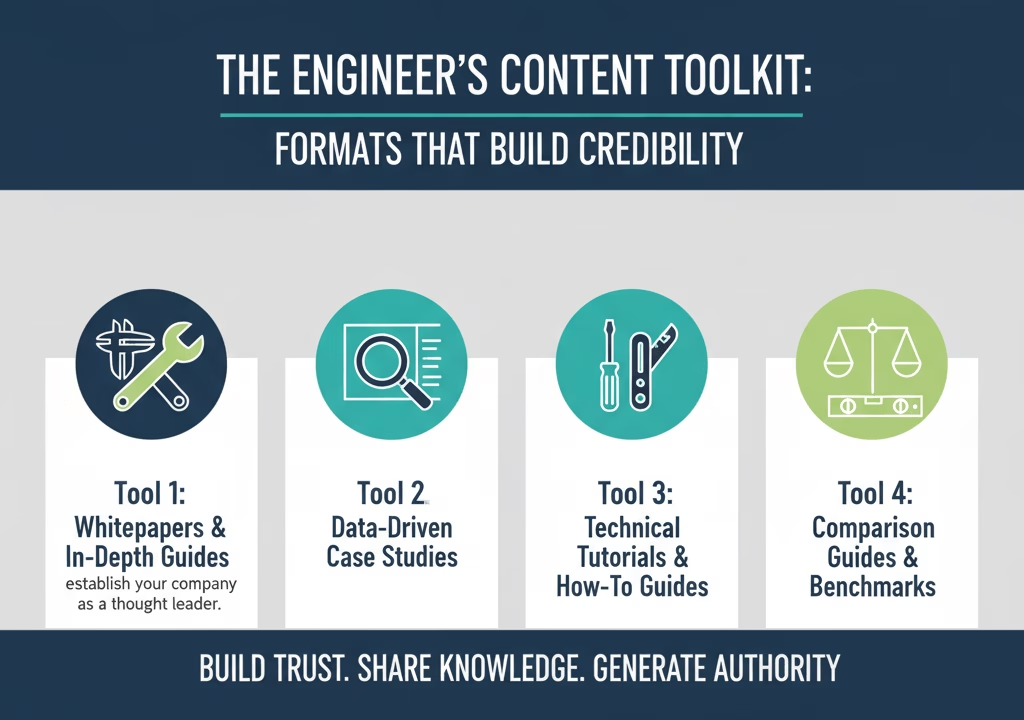
The Engineer’s Content Toolkit: Formats That Build Credibility
The format of your content is just as important as the content itself. Different formats are better suited for different purposes, and by choosing the right format for your message, you can increase its impact and credibility. The key is to select formats that allow for technical depth and provide genuine value to the reader.
In-Depth Guides and Whitepapers
In-depth guides and whitepapers are a cornerstone of technical content marketing. These long-form pieces of content allow you to go deep on a particular topic and provide a comprehensive overview of the subject matter, establishing your company as a thought leader. According to a 2025 report by the B2B Technology Marketing Community, 78% of B2B buyers use whitepapers to research purchasing decisions [3].
Data-Driven Case Studies
Case studies are one of the most effective types of content for building trust and credibility. They provide real-world examples of how your product has helped other companies solve their problems and achieve their goals. The key to a successful case study is to focus on the results. Don’t just tell your readers what you did; show them the impact that it had on the customer’s business, using quantifiable data wherever possible.
Key Takeaway: The most credible content is content that is backed by data and evidence. Show, don’t just tell.
Technical Tutorials and How-To Guides
Technical tutorials and how-to guides are a great way to provide practical value to your audience. By showing them how to solve a specific problem or complete a particular task, you can demonstrate your expertise and build trust. These types of content are also highly shareable and can help you reach a wider audience. They are a direct way to showcase your product’s capabilities in a real-world context.
Comparison Guides and Benchmarks
Comparison guides and benchmarks are a great way to show how your product stacks up against the competition. By providing a fair and objective comparison, you can help your customers make an informed decision and build trust in your brand. The key to a successful comparison guide is to be transparent and honest. Don’t be afraid to admit where your product falls short; your customers will appreciate your honesty and be more likely to trust you in the long run.
Building a Content Culture: How to Get Your Engineers to Share Their Knowledge
One of the biggest challenges in creating authentic technical content is getting the information out of the heads of your subject matter experts. Engineers are often focused on their core responsibilities and may not have the time or inclination to write blog posts. However, by creating a supportive content culture within your organization, you can make it easier for your engineers to share their invaluable knowledge and contribute to your content marketing success.
Overcoming the “Curse of Knowledge”
The “curse of knowledge” is a cognitive bias that occurs when an individual who is communicating with others assumes they have the same background to understand. This is a major hurdle when engineers attempt to communicate with a non-technical audience. To overcome this, encourage your engineers to use analogies, to explain concepts from first principles, and to have their content reviewed by non-technical colleagues. A simple question like, “Could my grandma understand this?” can be a powerful filter.
The “Lunch and Learn” Method for Content Collaboration
A highly effective way to get your engineers involved in content creation is to host regular “lunch and learn” sessions. These are informal meetings where engineers can present on a topic they are passionate about to the marketing team. The marketing team can then record these sessions, transcribe them, and use them as the basis for a wide range of content, from blog posts and articles to webinars and videos. This approach respects the engineer’s time while capturing their expertise in a low-pressure environment.
Key Takeaway: The best technical content is a collaboration between marketing and engineering. Build bridges, not silos.
Incentivizing and Recognizing Contributions
To encourage your engineers to contribute to your content marketing efforts, it is important to incentivize and recognize their contributions. This could be in the form of a bonus for every published article, a quarterly award for the most valuable contribution, or simply public recognition in a company-wide email or meeting. By showing your engineers that you value their contributions, you can create a virtuous cycle of content creation that will benefit your entire organization. Frame it not as a marketing task, but as an opportunity for them to build their professional brand and share their expertise with the world.
Measuring What Matters: How to Prove the ROI of Your Technical Content
One of the biggest challenges in content marketing is proving its return on investment (ROI). While it can be difficult to attribute a specific sale to a particular piece of content, there are a number of metrics that you can use to measure the effectiveness of your content marketing efforts and demonstrate its value to your organization.
Beyond Page Views: Tracking Engagement and Lead Quality
Page views are a good starting point, but they don’t tell the whole story. To truly understand the effectiveness of your content, you need to track engagement metrics such as time on page, bounce rate, and social shares. These metrics can give you a better sense of whether your content is resonating with your audience. You also need to track the quality of the leads that you are generating from your content. Are they a good fit for your business? Are they likely to become customers? By tracking lead quality, you can show that your content is not just generating traffic, but is also generating real business opportunities.
Using Gated Content to Capture High-Intent Leads
Gated content, such as whitepapers and ebooks, is a great way to capture high-intent leads. By requiring visitors to provide their contact information in exchange for access to your content, you can identify individuals who are genuinely interested in your products or services. This allows you to follow up with them in a more targeted and personalized way. The key to success with gated content is to ensure that the value you are providing is worth the price of admission.
Key Takeaway: The goal of content marketing is not just to generate traffic; it is to generate qualified leads that will turn into customers. Focus on the metrics that matter, and you will be able to prove the value of your content marketing efforts.
Ready to build a content engine that drives real results? Sign up for the GrowthBeaver waitlist and learn how we help technical B2B companies turn their expertise into a competitive advantage. By joining our community, you’ll gain access to exclusive insights and resources tailored to the unique challenges of the industry. We specialize in developing innovative manufacturing B2B marketing strategies that not only elevate your brand but also foster genuine connections with your target audience. Together, we can transform your knowledge into impactful content that resonates and drives sustainable growth.
About the Author
Stephan is a senior engineer with over 15 years of experience selling high-tech components to OEMs globally. Located in Zurich, Switzerland, he is addicted to understanding customers’ pains and hidden desires.
References
- Content Marketing Institute. (2025). *B2B Content Marketing: Benchmarks, Budgets, and Trends*.
- Journal of Technical Communication. (2026). *The Impact of Audience Analysis on Content Credibility*.
- B2B Technology Marketing Community. (2025). *The Power of Whitepapers in B2B Tech Marketing*.
FAQ:
Traditional content marketing often fails with engineers because it lacks the technical depth, data, and evidence that they require to build trust. Engineers are trained to be skeptical and are not easily swayed by marketing fluff or vague promises.
A simple way to translate features into benefits is to use the \”So What?\” test. For every feature that you list, ask yourself, \”So what?\” This will help you to drill down to the core value proposition of your product and explain how it will help your customers solve their problems.
The most effective content formats for a technical audience are those that provide in-depth information and practical value. These include in-depth guides and whitepapers, data-driven case studies, technical tutorials and how-to guides, and comparison guides and benchmarks.

