

Your engineering team builds world-class products. Your content marketing shouldn’t feel like amateur hour.
There is a frustrating disconnect in many technology companies. Engineering departments forge world-class products with precision and rigor, yet marketing efforts often feel like an afterthought, producing generic content that fails to connect with a technical audience. This gap between product excellence and marketing mediocrity is where opportunities are lost and competitors gain an edge.
Traditional content marketing advice often falls flat for tech companies. It’s designed for a different audience and a different sales process. The result is a cycle of creating content that doesn’t resonate, leading to a feeling of futility. But what if there was a better way? An approach that leverages the same precision and analytical mindset that goes into your products to create a content strategy that truly works.
The Technical Content Marketing Crisis
Why 82% of Tech Companies Struggle with Content Effectiveness
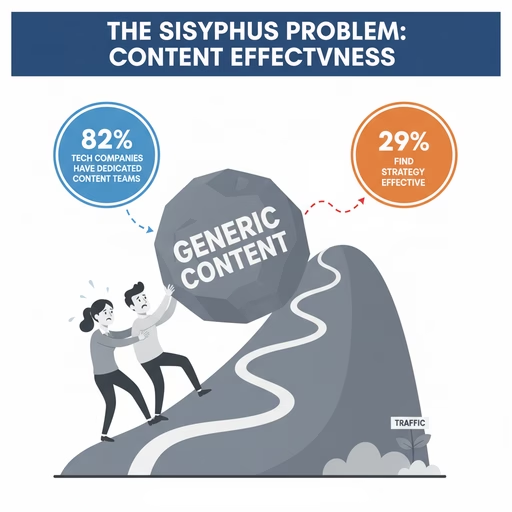
The data is clear: a staggering 82% of technology organizations have dedicated content teams, yet only 29% rate their content strategy as highly effective, according to recent research from the Content Marketing Institute. This points to a systemic problem. Teams are pushing a boulder up a hill, only to watch it roll back down, a phenomenon CMI has dubbed the “Sisyphus Problem” of content marketing.
Key Takeaway: Stop asking marketers to translate engineering genius. Your new content strategy should empower your engineers to communicate it directly, turning their expertise into your most potent marketing asset.
The Resource Trap: Small Teams, Big Expectations
Most tech content teams are small, with 2-5 people, yet they are tasked with the monumental job of creating content for a highly discerning audience. These teams are often stretched thin, forced to reduce their strategies to a “check-the-box” routine. This resource trap leads to burnout and a constant struggle to produce high-quality, in-depth content.
The Translation Problem: Features vs. Customer Value
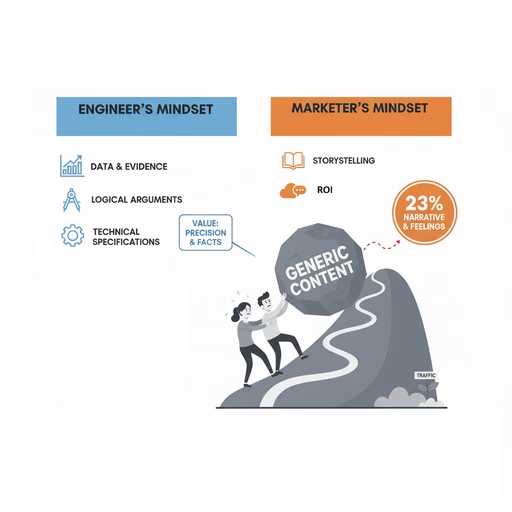
Engineers are trained to focus on technical specifications and features. Marketers are trained to focus on benefits and emotional appeal. This creates a translation problem. On one hand, content can become a dry list of technical specs; on the other hand, it can devolve into a fluffy piece of marketing that lacks substance. In either case, neither approach works for a technical buyer who needs to understand both the ‘what’ and the ‘so what
Here’s a practical example:
- Before (Feature-focused): Our actuator has a response time of 5ms.
- After (Value-focused): Reduce your line’s cycle time by 15% and eliminate production bottlenecks with an actuator that responds in 5ms—fast enough to keep pace with your most demanding automation tasks.
Understanding Your Technical Buyer
The Engineering Mindset: Data Over Hype
After more than a decade of selling complex components to OEMs, I’ve learned that engineers aren’t just skeptical; they’re professionally obligated to question everything. Your content must be robust enough to withstand that scrutiny. They value data, evidence, and a clear, logical argument. They are not persuaded by marketing hype or vague promises. Your content must be built on a foundation of credibility and expertise to earn their trust.
Key Takeaway: To connect with an engineering audience, you must speak their language. That means providing hard data, clear specifications, and logical explanations.
Content Preferences: What Engineers Actually Want to See
Research from TREW Marketing’s 2025 “State of Marketing to Engineers” report reveals a clear hierarchy of content preferences. At the top of the list are datasheets (79%), technical publication articles (61%), and CAD drawings (37%). In-depth blog posts, a staple of traditional content marketing, are valued by only 10% of technical buyers. This data shows that engineers prioritize content that helps them solve technical problems and make informed decisions.
The 60% Online Buying Process Reality
The same research shows that technical buyers spend, on average, 60% of their buying process online before ever speaking to a salesperson. This means your digital content is doing the heavy lifting in the sales process. A weak content strategy means you are losing potential customers before you even know they exist.
The Engineering-First Content Framework
To break out of the cycle of ineffective content, you need a new approach. The Engineering-First Content Framework is a systematic process designed for technical companies. It leverages your internal expertise to create content that is both technically accurate and commercially effective.
| Aspect | Traditional Content Marketing | Engineering-First Framework |
|---|---|---|
| Primary Goal | Brand awareness, lead generation | Technical problem-solving, lead qualification |
| Content Focus | Storytelling, emotional appeal | Data, specifications, application context |
| Key Metrics | Page views, social shares, MQLs | Datasheet downloads, demo requests, SQLs |
Phase 1: Technical Audit and Application Mapping
Start by looking inward. Conduct a thorough audit of your existing technical documentation, application notes, and internal knowledge bases. Map out every potential application for your products, no matter how niche. This internal audit is the foundation of your content strategy.
Phase 2: Customer Pain Point Engineering
For each application you’ve identified, reverse-engineer the customer’s pain points. What technical challenges are they facing? What problems are they trying to solve? Frame your product’s features as solutions to these specific problems. This is how you translate technical specs into customer value.
Key Takeaway: Your best content ideas are already inside your company. Start by mining your internal technical knowledge and then connect it to real-world customer problems.
Phase 3: Precision Content Creation
With a clear understanding of your applications and customer pain points, you can now create content with precision. Focus on the formats that technical buyers value most: datasheets, technical articles, and application-specific white papers. Every piece of content should have a clear purpose and a specific audience.
Phase 4: Technical Distribution Strategy
Your distribution strategy should be as precise as your content. Focus on the channels where technical buyers are actively seeking information. This includes technical publications, industry forums, and professional networks like LinkedIn. Don’t waste your time on channels that don’t reach your target audience.
Content Types That Convert Technical Buyers
Not all content is created equal. To convert technical buyers, you need to focus on the formats that provide the most value. Here are the top content types to prioritize:
- Datasheets and Technical Documentation (79% preference): This is the most valued content type for a reason. It provides the hard data and specifications that engineers need to do their jobs.
- Product Demonstrations and Case Studies: Show, don’t just tell. Demo videos and real-world case studies provide tangible proof of your product’s capabilities.
- Application-Specific White Papers: Go deep on a specific application or problem. A well-researched white paper can establish your company as a thought leader in your niche.
- Technical Comparison Content: Help your buyers make an informed decision by providing a fair and balanced comparison of different solutions. This builds trust and credibility.
Scaling Content with Limited Resources
The 80/20 Rule for Technical Content
You don’t need to create a massive volume of content to be effective. Focus on the 20% of content that will drive 80% of the results. This means prioritizing high-value, evergreen content that will continue to attract and engage your audience over time.
Leveraging Engineering Expertise for Content Creation
Your engineers are your most valuable content creators. Create a process for capturing their knowledge and turning it into content. This could be through interviews, brown bag lunches, or a simple Q&A process. Don’t let their expertise stay locked away.
Key Takeaway: Your engineers are your secret weapon in content marketing. Create a system to unlock their knowledge and turn it into high-value content.
Automation Tools for Technical Teams
Leverage automation to streamline your content creation and distribution process. This could include tools for content management, social media scheduling, and email marketing. The goal is to free up your team to focus on what they do best: creating high-quality, technical content.
Measuring Success: KPIs That Matter
Beyond Vanity Metrics: Technical Engagement Indicators
Don’t get caught up in vanity metrics like page views and social media likes. Focus on the metrics that truly indicate engagement with a technical audience. This includes metrics like time on page, download rates for technical documents, and the number of inquiries from qualified leads.
Sales-Marketing Alignment Metrics
The ultimate goal of content marketing is to drive sales. Track metrics that show the impact of your content on the sales pipeline. This could include the number of marketing-qualified leads (MQLs) that convert to sales-qualified leads (SQLs) and the influence of content on closed deals.
Application Discovery and Market Expansion Tracking
Your content can be a powerful tool for discovering new applications and markets for your products. Track the sources of your leads and look for patterns that indicate interest from new industries or use cases. This can provide valuable insights for your product and business development teams.
Implementation Roadmap
30-60-90 Day Action Plan
Don’t try to do everything at once. Create a phased implementation plan that focuses on making steady progress over time. In the first 30 days, focus on your technical audit and application mapping. In the next 60 days, start creating your first pieces of precision content. By day 90, you should have a repeatable process in place for creating and distributing high-value technical content.
Resource Allocation for Maximum Impact
Be strategic about how you allocate your limited resources. Invest in the content and channels that will have the biggest impact on your business. This may mean saying no to some of the tactics that are popular in traditional content marketing.
Common Pitfalls and How to Avoid Them
Be aware of the common pitfalls that can derail a technical content marketing strategy. This includes a lack of buy-in from leadership, a failure to involve engineering in the content process, and a focus on quantity over quality. By anticipating these challenges, you can take steps to avoid them.
Conclusion
The path to effective content marketing for tech companies is not about creating more content; it’s about creating the right content. By adopting an engineering-first approach, you can transform your technical expertise into a powerful marketing asset. This precision-engineered approach to content marketing for tech companies will not only help you connect with your target audience but also give you a sustainable competitive advantage in a crowded market.
Ready to build a content strategy as robust as your products? Join the GrowthBeaver waitlist and get access to the tools and insights you need to level up your technical content marketing.
Frequently Asked Questions
How is this different from regular B2B content marketing? The Engineering-First approach is specifically designed for a technical audience. It prioritizes data, evidence, and technical accuracy over traditional marketing tactics. It also focuses on leveraging your internal engineering expertise as the primary source of content. This approach not only builds credibility but also fosters trust among your audience, as they recognize the authenticity of the insights being shared. By integrating this methodology into your manufacturing B2B marketing strategies, you can create content that resonates more deeply with decision-makers who rely on technical details to drive their choices. Ultimately, this shift allows for more meaningful engagement and positions your brand as a thought leader in your industry.
What if we don’t have a marketing team? This framework is designed for resource-constrained teams. By focusing on the 80/20 rule and leveraging your existing technical documentation, you can create a highly effective content strategy without a large marketing team.
How do we measure ROI on technical content? Focus on metrics that are directly tied to business outcomes. This includes the number of qualified leads generated, the influence of content on the sales pipeline, and the discovery of new market opportunities.
Can this work for highly specialized technical products? Absolutely. In fact, the more specialized your product, the more effective this approach will be. By going deep on a specific niche, you can establish your company as the go-to expert in your field.
About the Author
Stephan is a senior engineer with over 15 years of experience selling high-tech components to OEMs globally. Based in Zurich, Switzerland, he is passionate about understanding customer pain points and hidden desires.

